

American Bistort
bistorta bistortoides
The American Bistort is a striking perennial herb native to the high-elevation meadows and alpine tundras of western North America. Rising on slender, upright stems from a thick, twisted underground rhizome, this resilient wildflower is celebrated for its dense, cylindrical clusters of small, white to pale pink blossoms. It serves as a classic indicator of healthy alpine ecosystems and is often found growing alongside other moisture-loving mountain flora, forming spectacular displays of summer blooms.
Habitat: Found in moist mountain meadows, marshy areas, and subalpine to alpine tundras of western North America.
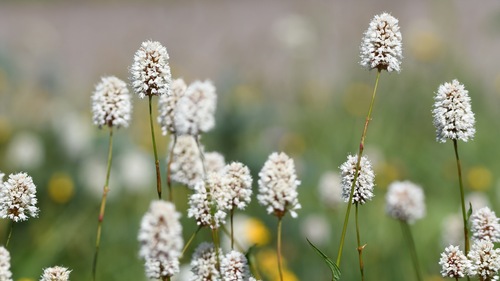
American Bistort is characterized by its tall, unbranched stems reaching 20 to 80 cm in height, tipped with a single, dense, cotton-swab-like flower spike that is 2 to 8 cm long. The spike is packed with dozens of tiny, five-lobed white or occasionally light pink flowers, which exhibit prominent protruding stamens that give the cluster a fuzzy appearance. Its leaves are primarily basal, oblong to lance-shaped with long petioles, and possess a leathery texture, while the few upper stem leaves are much smaller and clasp the stem directly.
Category
PlantsRarity
Common
Danger
1/5 · Very low
Snaps
3
Indigenous peoples of the Rocky Mountains boiled or roasted the starchy roots, which are said to have a nutty flavor similar to chestnuts.
The common name 'bistort' translates to 'twice-twisted' in Latin, which directly references the unique, S-shaped contortions of its underground rootstock.
The seeds of the American Bistort can be ground into a fine flour, which was historically used by Native Americans as a soup thickener and for baking bread.
Thrives in harsh high-altitude climates, surviving freezing nighttime temperatures and a very short summer growing season.
Utilizes thick, twisted underground stems to store complex carbohydrates, allowing rapid regrowth after the snow melts.
Produces a high density of florets in a single spike, maximizing visibility to scarce alpine pollinators in windy conditions.
As a photoautotrophic plant, it produces its own energy by utilizing chlorophyll to convert sunlight, carbon dioxide, and water into sugars.

Ursus arctos horribilis
Grizzly bears dig up and consume the nutrient-dense, starchy rhizomes in subalpine meadows during the spring and summer.
Ochotona princeps
American Pikas harvest and dry the stems and leaves of the plant to store in their winter haypiles.
Bombus occidentalis
Various alpine bumblebees visit the dense flower heads for pollen and nectar, facilitating pollination.
No trait badges are assigned for this object yet.
No aliases listed yet.
Collections for this object will appear here as more themes are added.
Danger
1/5 · Very low
No special safety notes yet.
The easiest way to identify American Bistort is to use the Snappit nature identifier app.
20-80 cm
3-15 years
As a photoautotrophic plant, it produces its own energy by utilizing chlorophyll to convert sunlight, carbon dioxide, and water into sugars.
Found in moist mountain meadows, marshy areas, and subalpine to alpine tundras of western North America.
Zoom in to split clusters and explore where this object has been snapped.

Colorado, US
You might spot Rocky Mountain Marsh-Marigold and American Bistort.
View guide →

Oregon, US
You might spot White Pasqueflower and Clark's Nutcracker.
View guide →

Colorado, US
You might spot Great Basin Bristlecone Pine and Fireweed.
View guide →

Colorado, US
You might spot Mountain Goat, Yellow-Bellied Marmot, and Bighorn Sheep.
View guide →
Take the discovery with you
Snap it with Snappit to identify it, learn what makes it special, and add the discovery to your collection.











.jpg&width=800)



_001.jpg&width=800)




