





American water-willow
Justicia americana
The American water-willow is a lovely plant that grows near water. It has long, green leaves and pretty flowers that attract butterflies and bees.
Habitat: Wetlands
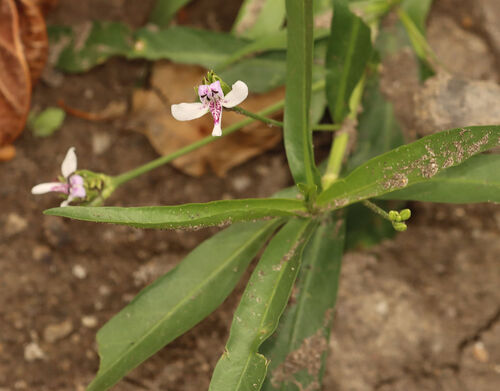
The American water-willow has upright, bamboo-like stems and narrow, lance-shaped leaves resembling those of a willow. Its delicate white to pale lavender flowers feature two lips and distinctive purple markings on the lower petal, making it stand out among other wetland plants.
Category
PlantsRarity
Common
Danger
1/5 · Very low
Snaps
18
Despite its name, it's not a true willow tree, but a flowering herb!
In some places, it’s used in rain gardens because it loves wet feet!
Its Latin name 'Justicia' honors a Scottish gardener, James Justice!
Some fish species, like minnows, hide their eggs among its underwater stems!
American water-willow can send out creeping rhizomes that help it spread quickly and form dense mats, holding soil in place.
Its dense root systems help filter sediments from water, improving water clarity and stabilizing stream banks against erosion.
This plant can thrive in submerged conditions, thanks to adaptations that allow its roots to tolerate low oxygen during floods.
Apis mellifera
collects nectar from its flowers
Bombus impatiens
gathers pollen and nectar
Notropis chalybaeus
fish hide among its dense underwater stems
Deciduous plants periodically shed all their leaves, typically during autumn or dry seasons.
Ornamental plants are cultivated primarily for their aesthetic appeal, enhancing landscapes and gardens with their attractive foliage, flowers, or form.
A shrub is a woody plant smaller than a tree, typically with multiple stems branching from or near the ground.
Summer blooming plants produce their flowers during the summer season, often providing vibrant color when many other plants have finished.

Fragrant flowers emit a pleasant aroma, often to attract pollinators or for defense.

Colorful describes organisms or objects displaying a wide range of bright and distinct colors.

Describes plants that are particularly attractive and beneficial to a wide range of pollinating organisms.

This habitat trait identifies species found in wetlands, which are areas of land saturated with water, either permanently or seasonally, including marshes, swamps, and bogs.
No aliases listed yet.
Danger
1/5 · Very low
Always stay on paths and don't touch unknown plants without asking an adult.
The easiest way to identify American water-willow is to use the Snappit nature identifier app.
15-75 cm
30-150 cm
1-2 cm
Late Spring to Late Summer
Yes
None
Perennial
Zoom in to split clusters and explore where this object has been snapped.
Sep 9, 2025
Marked Tree Lock and SiphonsPhoto attribution
(c) hr_dragonfly, some rights reserved (CC BY)
License: CC BY 4.0 ↗
Image may be shown cropped inside the card frame.

Tennessee, US
You might spot Pond Slider, White-Tailed Deer, and Great Blue Heron.
View guide →

Illinois, US
You might spot Eastern Red-Backed Salamander and Blanchard's Cricket Frog.
View guide →

Virginia, US
You might spot Canada Goose, Duck, and Great Blue Heron.
View guide →

Arkansas, US
You might spot Green Treefrog, Blue-Fronted Dancer, and Question Mark.
View guide →
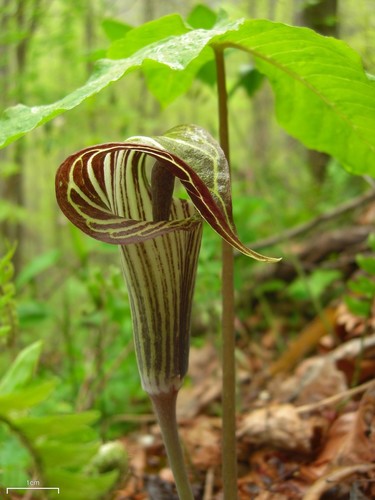
Kentucky, US
You might spot Jack-In-The-Pulpit and Prairie Trillium.
View guide →

Texas, US
You might spot Question Mark, Buttonbush, and Pomegranate.
View guide →
Take the discovery with you
Snap it with Snappit to identify it, learn what makes it special, and add the discovery to your collection.








.jpg&width=800)


_001.jpg&width=800)




