





Snowplant
Sarcodes sanguinea
The Snowplant is a bright red plant that grows in the mountains. It doesn't have leaves and gets its food from the ground, making it very special in the plant world!
Habitat: Mountain regions
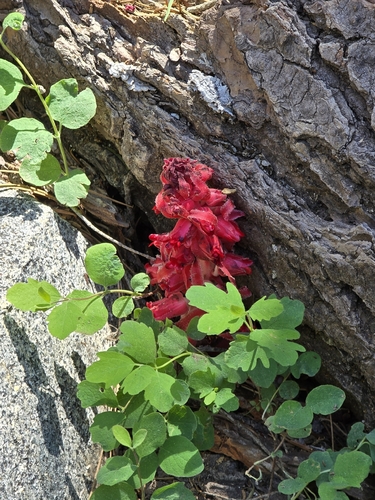
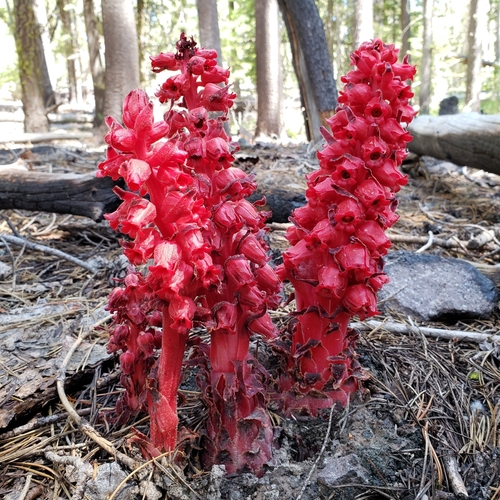
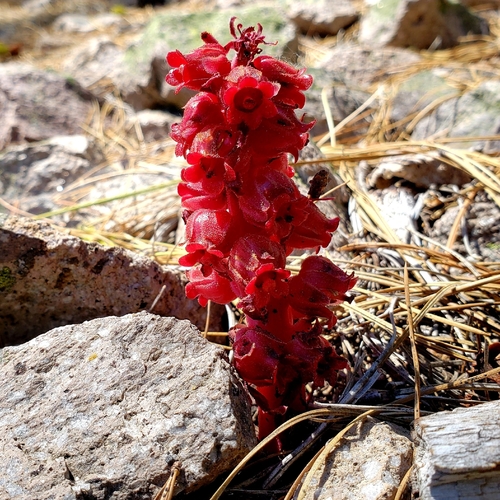
The Snowplant is a striking, bright red, cone-shaped plant emerging directly from the forest floor. It has no green leaves, instead displaying tiny scale-like structures along its thick, fleshy stem. Its vibrant color makes it stand out vividly against the surrounding soil and pine needles.
Category
PlantsRarity
Common
Danger
1/5 · Very low
Snaps
42
Early settlers sometimes thought Snowplants were alien life forms because they looked so unusual!
It can live underground for years before its red stalk finally pops up!
Its scientific name, 'Sarcodes sanguinea,' means 'fleshy bloody thing' in ancient Greek!
Though it looks like a mushroom, the Snowplant is a flowering plant that makes seeds!
Snowplant can 'steal' its food from underground fungi, allowing it to grow without needing sunlight.
Snowplant has a strong stalk that helps it push through cold soil, often appearing just after snowmelt.
Snowplant forms a special connection with fungi underground to get its food, staying hidden for years.
Rhizopogon roseolus
Snowplant gets nutrients from this fungus.
Pinus ponderosa
This tree provides sugars to the fungi Snowplant uses.
Bombus melanopygus
Bumblebees visit its bright red flowers to collect nectar.
This trait describes a symbiotic relationship between a fungus and the roots of a plant, benefiting both organisms.
Flowering plants are any plants that produce flowers as part of their reproductive cycle.
This trait characterizes plants lacking specialized vascular tissues (xylem and phloem) for transporting water and nutrients.
Shade tolerant plants are adapted to grow and thrive in areas with low light levels, requiring less direct sunlight.

Spring blooming plants produce their flowers during the spring season, often signifying the end of winter and the start of new growth.

Colorful describes organisms or objects displaying a wide range of bright and distinct colors.

This habitat trait identifies species found in mountainous regions, characterized by high elevation, steep slopes, and varying climate zones.

Endangered status indicates a species is at a very high risk of extinction in the wild in the near future.
No aliases listed yet.
Danger
1/5 · Very low
Do not touch or eat any wild plants without asking an adult first.
The easiest way to identify Snowplant is to use the Snappit nature identifier app.
15-50 cm
1-2 cm
Late spring to early summer
No
None
Perennial
Insect
Zoom in to split clusters and explore where this object has been snapped.
Jun 3, 2026
Generals' Highway Stone BridgesPhoto attribution
(c) Dan Killam, some rights reserved (CC BY)
License: CC BY 4.0 ↗
Image may be shown cropped inside the card frame.
Jun 30, 2019
Manzanita Lake Naturalist's Services Historic DistrictPhoto attribution
(c) Cristhian Mace, some rights reserved (CC BY)
License: CC BY 4.0 ↗
Image may be shown cropped inside the card frame.
Jun 30, 2019
Manzanita Lake Naturalist's Services Historic DistrictPhoto attribution
(c) Cristhian Mace, some rights reserved (CC BY)
License: CC BY 4.0 ↗
Image may be shown cropped inside the card frame.
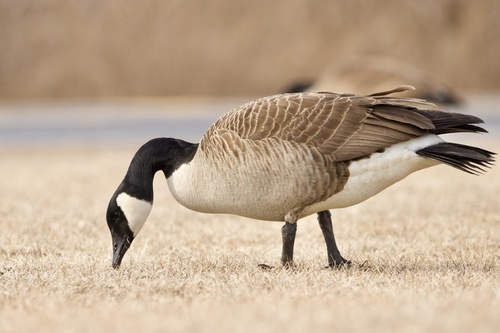
Nevada, US
You might spot Canada Goose, Antelope Bitterbrush, and Steller's Jay.
View guide →
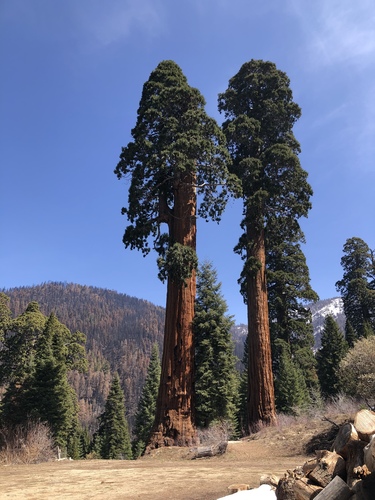
California, US
You might spot Sequoia, Mountain Misery, and Black Bear.
View guide →

California, US
You might spot Western Redbud and Harlequin Lupine.
View guide →

California, US
You might spot Sequoia, California Incense-Cedar, and White Fir.
View guide →

California, US
You might spot Chaparral Yucca and Grinnell's Beardtongue.
View guide →
California, US
You might spot Sequoia, Whiskerbrush, and Black Bear.
View guide →
Take the discovery with you
Snap it with Snappit to identify it, learn what makes it special, and add the discovery to your collection.








.jpg&width=800)



_001.jpg&width=800)



