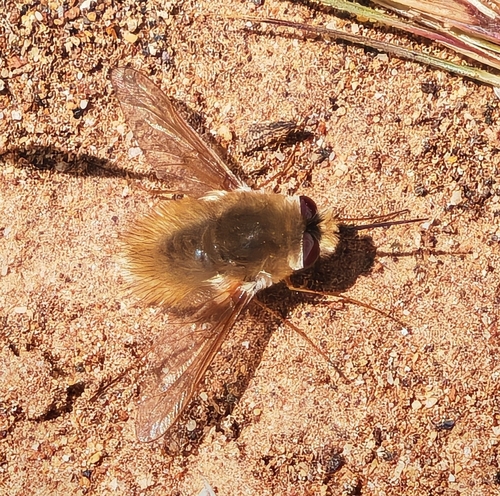


Anastoechus Latifrons
anastoechus latifrons
Anastoechus latifrons is a fascinating species of bee fly belonging to the family Bombyliidae. Renowned for their remarkable resemblance to bees, these insects are a classic example of Batesian mimicry. They sport dense, fuzzy hair that effectively deters potential predators who mistake them for stinging insects. While the adults are peaceful, nectar-loving pollinators that spend their days hovering over blooming desert flowers, their larvae lead a much darker and more secretive lifestyle. The larvae of Anastoechus latifrons are specialized predators or parasitoids of grasshopper egg pods, making them an important ecological control agent in their native arid habitats. Agile in the air, the adults can dart and hover with incredible precision, acting as vital pollinators while adding a dynamic, buzzing presence to the dry grasslands, scrublands, and deserts they inhabit.
Habitat: Found primarily in arid scrublands, dry grasslands, and sandy deserts where host grasshoppers and blooming nectar-plants are abundant.
This species is characterized by a stout, highly pilose (hairy) body, which gives it a distinctly fluffy, bee-like appearance. Its coloration typically features muted tones of buff, yellowish-tan, and brown, perfectly adapted to blend into sandy and arid environments. A prominent, rigid proboscis projects straight forward from its head, used to extract nectar from deep-throated flowers. The wings are largely transparent but may have a slight smoky tint near the leading edge. When at rest, the wings are held outstretched in a swept-back, delta-wing posture.
Category
InsectsRarity
Common
Danger
1/5 · Very low
Snaps
Be the first to snap!
Despite their intimidating fuzzy, bee-like appearance, bee flies do not possess stingers or venom and are entirely harmless to humans.
Their wings beat at an incredibly high frequency, creating a distinct buzzing sound that further sells the illusion that they are stinging bees.
When a female is ready to lay her eggs, she hovers just above the ground and flicks her sand-coated eggs forcefully into cracks in the soil near grasshopper burrows.
It heavily mimics the visual appearance and buzzing sound of a bumblebee to deter predators, despite having no stinger or venom.
Highly evolved flight mechanics allow this fly to hover completely motionless in mid-air and dart away instantly when threatened.
Females collect sand in a specialized abdominal chamber to coat their eggs before laying them, which weighs the eggs down and hides them from predators.
Adults exclusively feed on floral nectar and pollen, while the larval stage is strictly carnivorous, consuming grasshopper egg pods.
Age differences: Undergoes a radical dietary shift: larvae are carnivorous predators of grasshopper eggs, whereas adults are exclusively nectar-feeding herbivores.

Melanoplus sanguinipes
Larvae consume the buried egg pods of grasshoppers, acting as a natural population control.

Ericameria nauseosa
Adult flies are frequent visitors and important pollinators for late-blooming desert shrubs.
Efferia aestuans
Adults are frequently hunted in mid-air by larger, predatory flies.
No trait badges are assigned for this object yet.
No aliases listed yet.
Collections for this object will appear here as more themes are added.
Danger
1/5 · Very low
No special safety notes yet.
Look for six legs, antennae, three body sections and the shape of the wings. Beetles have hardened front wings; flies have just one working pair. Tiny insects may need a close view before their group is clear. Insect Identifier: upload a photo and compare the visible details.
1-2 cm
1-3 cm
0.0001-0.0003 kg
up to 1 years
15 km/h
Adults exclusively feed on floral nectar and pollen, while the larval stage is strictly carnivorous, consuming grasshopper egg pods.
Found primarily in arid scrublands, dry grasslands, and sandy deserts where host grasshoppers and blooming nectar-plants are abundant.
Zoom in to split clusters and explore where this object has been snapped.
Recent snaps will appear here as new observations are added.
Take the discovery with you
Snap it with Snappit to identify it, learn what makes it special, and add the discovery to your collection.