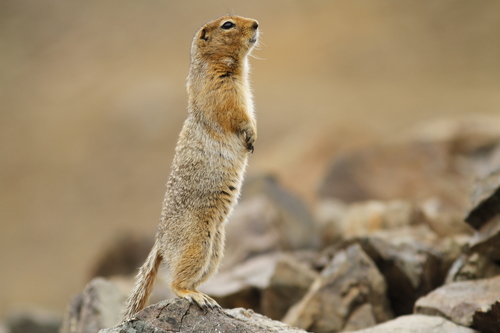


Arctic Ground Squirrel
urocitellus parryii
The Arctic Ground Squirrel is a resilient and highly social rodent native to the wind-swept tundras, alpine meadows, and river valleys of North America and Siberia. As the largest of the North American ground squirrels, they have developed extraordinary adaptations to survive some of the harshest winters on Earth. These animals live in tight-knit colonies and excavate elaborate burrow systems in the sandy, well-drained soils above the permafrost, constantly communicating with their neighbors using a complex vocabulary of bird-like chirps and whistles to warn of approaching predators.
Habitat: Found in open arctic tundra, alpine meadows, and sandy river banks with well-drained soils above the permafrost layer.
The Arctic Ground Squirrel has a robust, cylindrical body with a short, flat tail, measuring around 33 to 50 centimeters in total length. Its dense coat features a beautiful mottled pattern of reddish-brown, tan, and gray fur, thickly speckled with distinct white spots along its back. The face, shoulders, and sides of its neck are washed with a warm, rusty-cinnamon color, while its underparts are a pale cream or light tan. It has small, rounded ears set flat against its skull to minimize heat loss, and strong, dark claws specialized for digging through tough tundra soils.
Category
MammalsRarity
Common
Danger
1/5 · Very low
Snaps
Be the first to snap!
Male Arctic ground squirrels wake up from hibernation up to three weeks earlier than females, using cached seeds to regain muscle mass and elevate testosterone levels before mating.
They are known to occasionally scavenge on the carcasses of other animals, including snowshoe hares, to secure high-quality proteins and fats for the winter.
To achieve supercooling, these squirrels purge their blood of any potential ice-nucleating agents, preventing ice crystals from forming in their blood vessels.
During hibernation, their core body temperature drops below freezing to as low as -2.9 degrees Celsius without solidifying, the lowest measured temperature of any living mammal.
They coordinate colony defense by posting sentries who use high-pitched, bird-like whistles to warn others of aerial or terrestrial threats.
Upon waking from hibernation, their brains rapidly rebuild shrunken neural connections within hours to quickly restore full cognitive function.
An opportunistic feeder that primarily consumes tundra plants, seeds, and berries, but heavily supplements its diet with insects, mushrooms, and animal carrion to build crucial fat reserves.
Age differences: Juveniles focus on consuming tender green vegetation and high-energy seeds, whereas adults consume more diverse items, including larger insects and carrion, to quickly gain fat prior to hibernation.

Ursus arctos horribilis
Grizzly bears hunt Arctic ground squirrels by vigorously digging up their burrow systems, especially during late summer.

Vulpes lagopus
The Arctic fox hunts ground squirrels, relying heavily on them and their pups as a key food source during the summer breeding season.

Bubo scandiacus
Snowy owls hunt ground squirrels from elevated perches, preying on individuals that forage too far from burrow entrances.
No trait badges are assigned for this object yet.
No aliases listed yet.
Collections for this object will appear here as more themes are added.
Danger
1/5 · Very low
No special safety notes yet.
Compare ears, muzzle, tail, feet and coat markings. Size is hard to judge without something nearby for scale, and young mammals may not have adult coloring yet. Mammal Identifier: upload a photo and compare the visible details.
33-50 cm
0.4-1.2 kg
3-6 years
30 km/h
An opportunistic feeder that primarily consumes tundra plants, seeds, and berries, but heavily supplements its diet with insects, mushrooms, and animal carrion to build crucial fat reserves.
Found in open arctic tundra, alpine meadows, and sandy river banks with well-drained soils above the permafrost layer.
Foraging
Zoom in to split clusters and explore where this object has been snapped.
Recent snaps will appear here as new observations are added.
Take the discovery with you
Snap it with Snappit to identify it, learn what makes it special, and add the discovery to your collection.