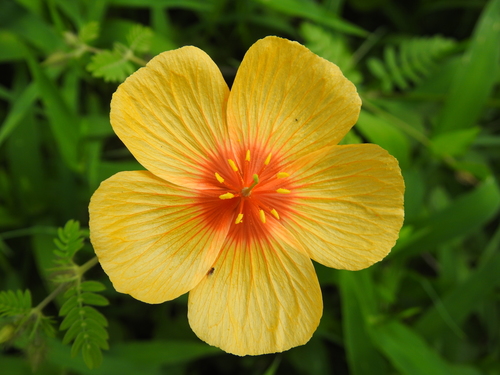


Arizona Poppy
kallstroemia grandiflora
The Arizona Poppy (Kallstroemia grandiflora), despite its common name, is not a true poppy but a member of the caltrop family. This vibrant annual herb transforms the arid landscapes of the Chihuahuan and Sonoran Deserts into spectacular carpets of brilliant orange following summer monsoon rains. Growing quickly from seed, it spreads low across the ground before sending up leafy stems adorned with large, showy blossoms that closely mimic the appearance of California poppies. It serves as a vital resource for desert pollinators, attracting a diverse array of bees, butterflies, and other insects during its brief but explosive blooming period.
Habitat: Found in arid grasslands, desert flats, and sandy disturbed areas of the southwestern United States and northern Mexico, blooming prolifically after summer rains.
The Arizona Poppy features bright, cup-shaped flowers measuring up to 6 cm across with five brilliant orange petals, often displaying a deeper red or orange spot at the base. Its stems are hairy, branching, and can trail along the ground or grow upright up to 100 cm tall. The leaves are opposite, pinnately compound, and divided into several pairs of small, elliptical leaflets that give the foliage a delicate, feathery appearance. Following pollination, it produces a distinctive, dry, beaked fruit that eventually splits into several nutlets.
Category
PlantsRarity
Common
Danger
1/5 · Very low
Snaps
1
Despite its common name and striking orange petals, the Arizona Poppy is not a true poppy and belongs to the caltrop family (Zygophyllaceae) rather than the poppy family (Papaveraceae).
The flowers open in the morning and face eastward, rotating throughout the day to track the sun until they close in the late afternoon.
The plant's seeds can survive extreme desert heat and prolonged droughts, remaining viable in the soil for several years before germinating.
Rapidly germinates, grows, and flowers in response to late-summer monsoonal rains to maximize the brief window of desert moisture.
Flowers exhibit heliotropism, tracking the sun's movement across the sky to keep reproductive organs warm and highly attractive to pollinators.
Produces highly durable, tough-coated seeds that can lie dormant in parched desert soils for multiple years until ideal moisture conditions return.
As an autotrophic plant, the Arizona Poppy generates its own food via photosynthesis, utilizing sunlight, carbon dioxide, water, and minerals absorbed through its root system.
Caupolicana yarrowi
Provides nectar and pollen to specialized desert bees, facilitating its own pollination in the process.
Schistocerca shoshone
The foliage is consumed by desert grasshoppers during the late summer monsoonal bloom.

Larrea tridentata
Competes for limited water, space, and soil nutrients in sandy desert washes.
No trait badges are assigned for this object yet.
No aliases listed yet.
Collections for this object will appear here as more themes are added.
Danger
1/5 · Very low
No special safety notes yet.
The easiest way to identify Arizona Poppy is to use the Snappit nature identifier app.
30-100 cm
1 years
As an autotrophic plant, the Arizona Poppy generates its own food via photosynthesis, utilizing sunlight, carbon dioxide, water, and minerals absorbed through its root system.
Found in arid grasslands, desert flats, and sandy disturbed areas of the southwestern United States and northern Mexico, blooming prolifically after summer rains.
Foraging
Zoom in to split clusters and explore where this object has been snapped.
Take the discovery with you
Snap it with Snappit to identify it, learn what makes it special, and add the discovery to your collection.












.jpg&width=800)



_001.jpg&width=800)




