
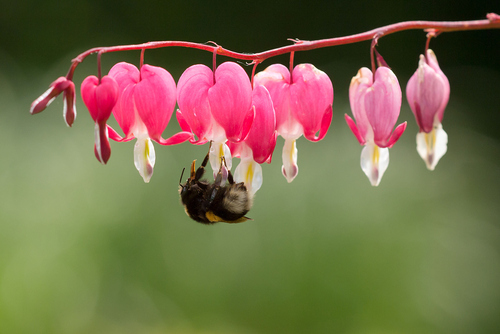


Asian Bleeding-Heart
lamprocapnos spectabilis
The Asian Bleeding-Heart (Lamprocapnos spectabilis) is a beloved herbaceous perennial renowned for its extraordinarily unique, heart-shaped blossoms. Native to the moist woodlands and montane regions of eastern Asia, this species has captured the imagination of gardeners and nature enthusiasts worldwide. It rises in early spring, unfurling delicate, fern-like foliage before producing elegant, arching stems from which a series of dangling, pillow-like flowers hang in a perfect, orderly row. Each flower looks like a tiny, dripping heart, giving the plant its highly descriptive common name. As a classic spring ephemeral, it bursts with life during the cool, wet months of spring and often retreats into complete dormancy beneath the soil when the summer heat intensifies. Its combination of botanical elegance, toxicity-driven resilience, and striking morphology makes it one of the most recognizable and cherished woodland plants in the northern hemisphere.
Habitat: Found in moist, shaded temperate forests, deciduous woodlands, rocky slopes, and alpine valleys across eastern Asia.
This herbaceous perennial typically grows 60 to 120 cm tall, forming a soft, mounded clump of compound, deeply-lobed leaves of a light green to bluish-green hue. Its most striking feature is the horizontal, arching racemes that support 3 to 15 dangling flowers. Each heart-shaped flower measures about 2 to 5 cm in length, featuring outer petals of a rich rose-pink to fuchsia and inner white petals that protrude from the bottom, resembling a droplet. Cultivated varieties may also present pure white ('Alba') or golden-yellow foliage ('Gold Heart').
Category
PlantsRarity
Common
Danger
1/5 · Very low
Snaps
Be the first to snap!
Despite its beautiful appearance, all parts of the Asian Bleeding-Heart are toxic to humans and pets, containing alkaloids that can cause skin irritation or stomach upset.
In traditional folklore, squeezing the flower in different directions was used to tell theatrical love stories, with parts representing slippers, a harp, or bottles.
The common name 'bleeding heart' comes from the shape of the flower, which looks like a classic heart icon with a white drop sliding out of the bottom.
To survive extreme heat and drought, the plant undergoes estivation, completely dying back to its underground root system in mid-summer.
Its seeds bear lipid-rich appendages called elaiosomes, which entice ants to carry the seeds to their nests, assisting in plant dispersal.
The plant synthesizes toxic isoquinoline alkaloids throughout its tissues, making it highly unpalatable and toxic to grazing mammals.
As a photosynthetic plant, it generates its own energy from sunlight, carbon dioxide, and water while absorbing key minerals from the soil.
Bombus bimaculatus
Provides early-season nectar to bumblebees which are robust enough to open the tightly closed petals to reach the nectar.
Myrmica rubra
Ants carry the seeds back to their underground colony to feed on the nutritious elaiosome, effectively planting the seed in rich soil.
Deroceras reticulatum
May feed on the tender emerging spring foliage and stems, especially in damp, shaded garden conditions.
No trait badges are assigned for this object yet.
No aliases listed yet.
Collections for this object will appear here as more themes are added.
Danger
1/5 · Very low
No special safety notes yet.
Start with the whole plant, then compare leaf arrangement, leaf edges, stems and any flowers or fruit. Opposite leaves grow in pairs; alternate leaves come one at a time along the stem. These details tell you far more together than a single green leaf does. Plant Identifier: upload a photo and compare the visible details.
60-120 cm
5-15 years
As a photosynthetic plant, it generates its own energy from sunlight, carbon dioxide, and water while absorbing key minerals from the soil.
Found in moist, shaded temperate forests, deciduous woodlands, rocky slopes, and alpine valleys across eastern Asia.
Foragingzoneextraction/photosynthesis
Zoom in to split clusters and explore where this object has been snapped.
Recent snaps will appear here as new observations are added.
Take the discovery with you
Snap it with Snappit to identify it, learn what makes it special, and add the discovery to your collection.


















