

Asian Clam
corbicula fluminea
The Asian Clam (Corbicula fluminea) is a small but mighty freshwater bivalve that has made a massive impact on aquatic ecosystems worldwide. Originally native to eastern and southeastern Asia, this adaptable creature has become one of the most successful invasive aquatic species, spreading rapidly across the Americas, Europe, and Africa. Known for their prolific reproduction and hardy nature, Asian clams can quickly establish incredibly dense colonies, sometimes blanketing riverbeds in the thousands per square meter. While they are fascinating marvels of biological efficiency, their success often comes at a steep cost to native habitats, as they outcompete local mollusks for food and space. Spotting an Asian clam shell along a riverbank is a testament to the incredible resilience and widespread global journey of this highly effective filter feeder.
Habitat: Found in freshwater rivers, lakes, and streams, often burrowed into sandy or gravelly substrates.
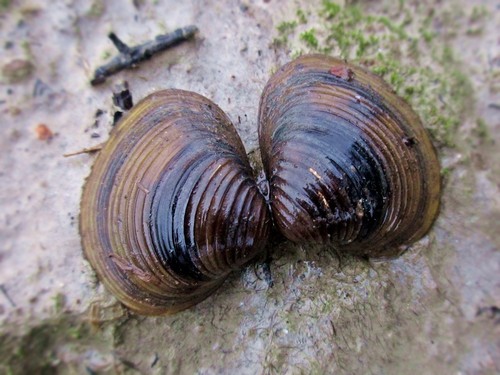
The Asian clam features a sturdy, roughly triangular or rounded shell that typically measures less than 5 centimeters (2 inches) across. Its most distinctive visual hallmark is the presence of deep, evenly spaced, pronounced concentric ridges across the outer surface of its valves, which easily distinguish it from smoother native freshwater mussels. The shell's exterior color varies significantly depending on its environment, ranging from yellowish-green and light brown to deep olive or nearly black. Inside, the shell is smooth and polished, often exhibiting a striking pale blue, white, or subtle purple tint, particularly near the hinge area.
Category
InvertebrateRarity
Common
Danger
1/5 · Very low
Snaps
2
Because they are simultaneous hermaphrodites, a single Asian clam can self-fertilize and release up to 35,000 juveniles in a single breeding season, essentially starting an invasion single-handedly.
In their native range across Asia, they are sometimes harvested for human consumption and used in traditional dishes or soups, despite their small size.
They are notorious 'biofoulers,' known to severely clog the water intake pipes of power plants and industrial facilities, costing millions of dollars in damages annually.
When disturbed or facing poor water quality, Asian clams will tightly shut their strongly ridged shells and can survive for weeks without drawing in fresh water.
As a simultaneous hermaphrodite, a single individual can self-fertilize to reproduce, meaning one clam alone can start a new colony in a new habitat.
Before their gills are fully developed enough for filter feeding, juveniles use their muscular foot to sweep organic detritus and algae directly into their mantle cavity.
Young Asian clams secrete sticky byssal threads that allow them to anchor securely to rocks, gravel, and submerged debris, preventing them from being swept away by strong currents.
Asian clams are highly efficient filter feeders that draw in surrounding water to extract suspended microscopic organic material.
Age differences: Juveniles rely on pedal feeding (using their foot to gather food from the sediment) until their gills fully develop to support filter feeding.
Cyprinus carpio
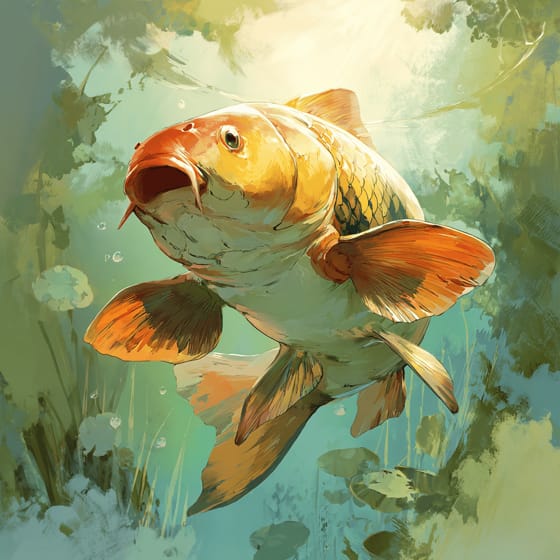
Common carp forage heavily on bottom-dwelling invertebrates and frequently crush and eat Asian clams.
Dreissena polymorpha
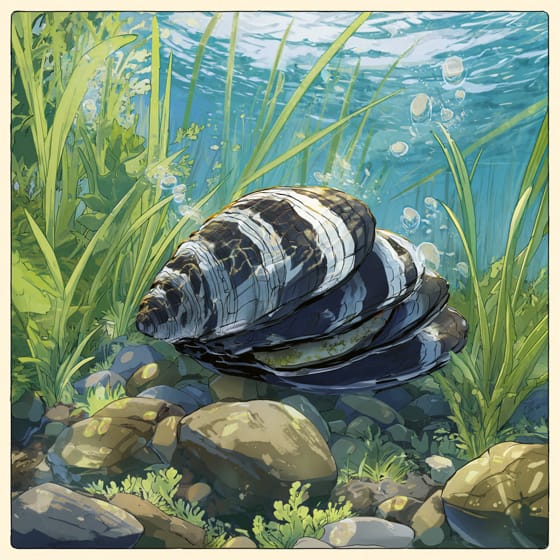
Both are highly invasive filter feeders that intensely compete for space and suspended food particles in shared freshwater habitats.

Procyon lotor
Raccoons forage along shallow shorelines and riverbanks, frequently digging up and eating Asian clams.
No trait badges are assigned for this object yet.
No aliases listed yet.
Collections for this object will appear here as more themes are added.
Danger
1/5 · Very low
No special safety notes yet.
The easiest way to identify Asian Clam is to use the Snappit nature identifier app.
1-5 cm
0.001-0.02 kg
1-7 years
Asian clams are highly efficient filter feeders that draw in surrounding water to extract suspended microscopic organic material.
Found in freshwater rivers, lakes, and streams, often burrowed into sandy or gravelly substrates.
Filtering
10000-70000
Zoom in to split clusters and explore where this object has been snapped.

Illinois, US
You might spot Eastern Red-Backed Salamander and Blanchard's Cricket Frog.
View guide →

Alabama, US
You might spot Blackfin Darter and Largescale Stoneroller.
View guide →

Washington, US
You might spot Duck, American Wigeon, and Ring-Billed Gull.
View guide →

Oregon, US
You might spot Canada Goose, Duck, and Greater White-Fronted Goose.
View guide →

Washington, US
You might spot Strawberry Tree, Duck, and American Beaver.
View guide →
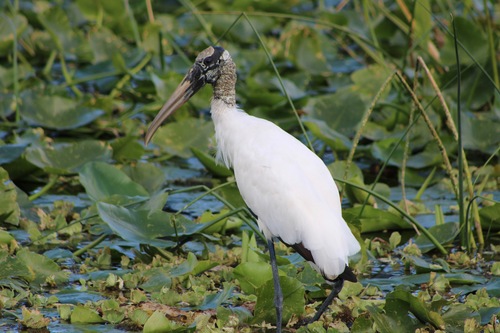
Florida, US
You might spot Wood Stork, Brown Anole, and Taro.
View guide →
Take the discovery with you
Snap it with Snappit to identify it, learn what makes it special, and add the discovery to your collection.