

Balearic Warbler
curruca balearica
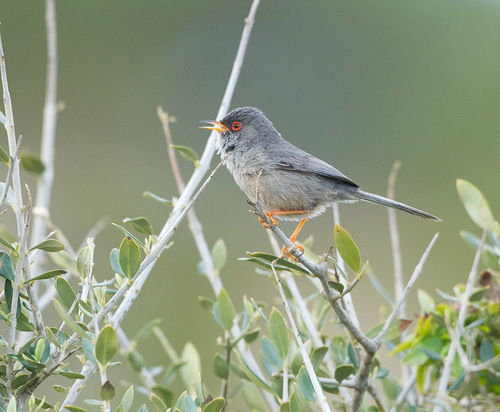
The Balearic Warbler is a small, energetic passerine endemic to the sun-baked scrublands of the Balearic Islands in Spain. Once considered a subspecies of Marmora’s Warbler, this diminutive bird was officially recognized as its own distinct species due to its unique vocalizations and subtle morphological differences. Skulking and elusive by nature, it blends perfectly into the dense, thorny bushes of its Mediterranean island home, revealing its presence mostly through sudden, harsh rattling calls. It is a quintessential island specialist, tightly linked to the native garrigue and maquis vegetation. Birdwatchers traveling to Mallorca or Ibiza often seek out this charming warbler, admiring its habit of nervously flicking its long tail as it flits between low shrubs. Its resilience in rocky, arid habitats makes it a fascinating example of insular adaptation in European avifauna.
Habitat: Found almost exclusively in dry, open Mediterranean scrublands, rocky coastal hillsides, and low heath ecosystems characterized by mastic trees and dwarf palms.
This small warbler measures roughly 12 to 13 centimeters in length, characterized by a noticeably long tail that is frequently cocked upwards. Adult males display bluish-grey upperparts and pale greyish-pink underparts, accompanied by a striking, bright red orbital ring surrounding the eye. Females and juveniles are similar in shape but are generally browner and less vibrantly colored. They possess a thin, pointed dark bill adapted for insect-catching and relatively pale, yellowish-brown legs.
Category
BirdsRarity
Common
Danger
1/5 · Very low
Snaps
Be the first to snap!
Both parents take turns incubating the eggs and defending their small, cup-shaped nests hidden deep within thorny shrubs.
For many years, the Balearic Warbler was considered the same species as Marmora's Warbler, which lives on neighboring islands like Corsica and Sardinia.
Unlike many European warblers, it almost never migrates, spending its entire life hopping through the same patches of island scrub where it was born.
When agitated, this tiny bird will aggressively flick its long tail up and down while emitting a rattling scold to ward off intruders.
Moves with exceptional stealth through dense, thorny scrub, making it extremely difficult for predators to spot and track.
Highly adapted to thrive in hot, arid Mediterranean island microclimates where fresh surface water is largely scarce.
Uses a highly mobile, tail-flicking foraging technique to balance while gleaning insects from the undersides of leaves and narrow branches.
The Balearic Warbler primarily sustains itself by foraging for small insects and spiders within low, dense vegetation.
Age differences: Chicks are fed exclusively soft-bodied insects like caterpillars to provide hydration and ensure rapid growth.
Pistacia lentiscus
Frequently nests in the dense cover provided by mastic shrubs.
Falco eleonorae
Preyed upon by small falcons that patrol the island scrublands.
Curruca melanocephala
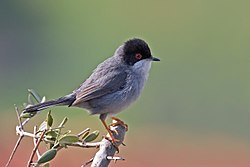
Shares similar habitat and competes for insect resources in the scrub.
Formicidae
Actively hunts and consumes small ground and foliage-dwelling insects.
No trait badges are assigned for this object yet.
No aliases listed yet.
Collections for this object will appear here as more themes are added.
Danger
1/5 · Very low
No special safety notes yet.
Compare the silhouette, bill shape, tail length, wing bars and markings around the eyes. The same small brown bird at your feeder can look quite different in breeding plumage, winter plumage or its first year. Bird Identifier: upload a photo and compare the visible details.
12-13 cm
15-17 cm
0.009-0.012 kg
3-5 years
The Balearic Warbler primarily sustains itself by foraging for small insects and spiders within low, dense vegetation.
Found almost exclusively in dry, open Mediterranean scrublands, rocky coastal hillsides, and low heath ecosystems characterized by mastic trees and dwarf palms.
Foraging
Zoom in to split clusters and explore where this object has been snapped.
Recent snaps will appear here as new observations are added.
Take the discovery with you
Snap it with Snappit to identify it, learn what makes it special, and add the discovery to your collection.