
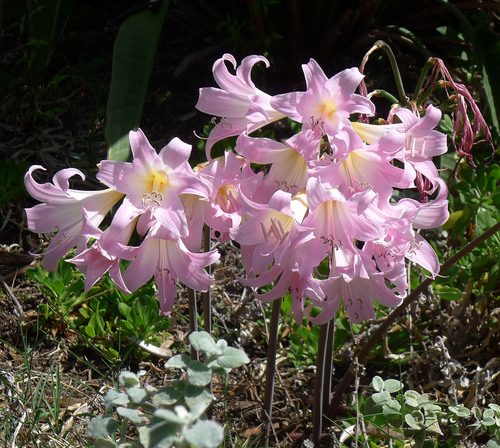


Belladonna Lily
amaryllis belladonna
The Belladonna Lily, also famously known as the Naked Lady, is a striking geophytic perennial native to the rocky hillsides of South Africa. This resilient plant is celebrated for its unusual growth habit: in late summer, stout, purplish-brown stems shoot up rapidly from the dry soil, bearing clusters of large, fragrant, trumpet-shaped flowers. Curiously, these blooms appear entirely on their own, long after the winter foliage has died back, giving the plant its whimsical 'naked' moniker. Beyond its captivating beauty, the Belladonna Lily is a tough survivor. It has adapted to thrive in Mediterranean climates, utilizing its large underground bulb to store water and nutrients through harsh, dry summers. Its sweet, heavy scent wafts through the warm evening air, attracting night-flying pollinators like hawk moths, which are vital for its reproduction in both its native habitat and naturalized regions around the world.
Habitat: Typically found on dry, rocky, open slopes and coastal hillsides within Mediterranean-type shrubland ecosystems.
This plant is easily identified by its naked, leafless flower scapes that rise 30 to 75 centimeters tall, bearing clusters of 2 to 12 large, trumpet-shaped blossoms. The flowers are typically a delicate pale pink to deep rose, though white-flowered variants also exist, and they emit a sweet, bubblegum-like fragrance. Each bloom features six recurved tepals surrounding prominent yellow-anthered stamens. The strap-like, dark green leaves only emerge after the flowering period has ended, growing in a basal rosette that dies back by early summer, leaving the bulb dormant beneath the soil.
Category
PlantsRarity
Common
Danger
1/5 · Very low
Snaps
Be the first to snap!
All parts of the Belladonna Lily, particularly the bulb, contain the toxic alkaloid lycorine, which can cause severe vomiting and distress if ingested by animals or humans.
Despite its common name 'Amaryllis belladonna', this is the only true species in the genus Amaryllis; the popular winter-blooming houseplants called 'Amaryllis' actually belong to the genus Hippeastrum.
The nickname 'Naked Lady' comes from the plant's unique habit of blooming on completely bare stems, long after its leaves have withered away.
The plant produces flowers on leafless stems during the dry season, conserving water and making the blooms highly visible to pollinators.
Contains high amounts of toxic alkaloids, including lycorine, which deter herbivores, rodents, and insects from feeding on its bulbs and foliage.
Utilizes a massive underground bulb to store water and energy, allowing it to survive prolonged summer droughts and wildfire events.
As a photoautotrophic plant, the Belladonna Lily synthesizes its own food using sunlight, carbon dioxide, and water through photosynthesis, supplemented by soil minerals absorbed by its roots.
Age differences: Seedlings rely initially on nutrient reserves stored within the seed before developing roots to absorb water and minerals independently.
Agrius convolvuli
The Convolvulus Hawk Moth acts as a primary pollinator, attracted to the lily's strong fragrance during dusk and nighttime.

Cornu aspersum
Common garden snails feed on the emerging leaves and flowers, despite the plant's toxicity.
No trait badges are assigned for this object yet.
No aliases listed yet.
Collections for this object will appear here as more themes are added.
Danger
1/5 · Very low
No special safety notes yet.
Start with the whole plant, then compare leaf arrangement, leaf edges, stems and any flowers or fruit. Opposite leaves grow in pairs; alternate leaves come one at a time along the stem. These details tell you far more together than a single green leaf does. Plant Identifier: upload a photo and compare the visible details.
30-75 cm
0.1-0.6 kg
10-50 years
As a photoautotrophic plant, the Belladonna Lily synthesizes its own food using sunlight, carbon dioxide, and water through photosynthesis, supplemented by soil minerals absorbed by its roots.
Typically found on dry, rocky, open slopes and coastal hillsides within Mediterranean-type shrubland ecosystems.
Zoom in to split clusters and explore where this object has been snapped.
Recent snaps will appear here as new observations are added.
Take the discovery with you
Snap it with Snappit to identify it, learn what makes it special, and add the discovery to your collection.


















