

Berthelot'S Pipit
anthus berthelotii
Berthelot's Pipit is a charming, resilient songbird native to the rugged Macaronesian archipelagos of the Canary Islands, Madeira, and the Selvagens. Despite the harsh, arid conditions of these volcanic islands, this small, ground-dwelling passerine thrives in open, sandy, and rocky terrains where other birds might struggle. Known for its energetic running style and bold personality, it is often seen darting across barren landscapes in search of small insects. Unlike many of its migratory relatives, Berthelot's Pipit is a sedentary species, remaining on its home islands year-round. It has successfully adapted to human-altered environments, showing remarkable curiosity rather than fear when encountering humans. Observing this little bird dash between volcanic rocks with its bobbing tail is a quintessential experience for anyone exploring the wilder paths of Macaronesia.
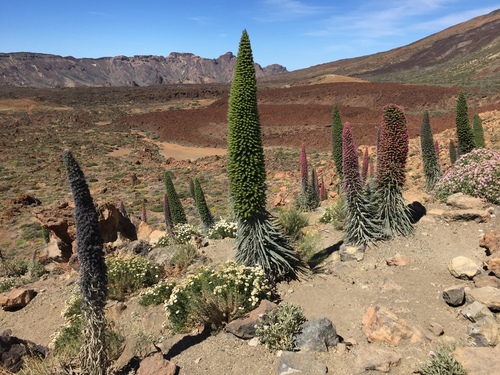
Habitat: Found in dry, open habitats including volcanic ash fields, sandy dunes, scrubby semi-deserts, and rocky slopes with sparse vegetation.
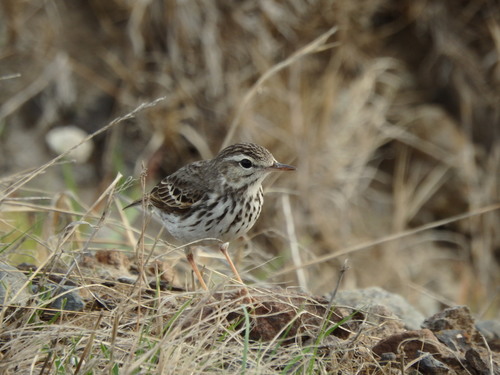
Berthelot's Pipit is a slender, petite bird measuring about 13 to 15 centimeters in length. Its plumage is a masterclass in desert camouflage, featuring sandy-grey or light brown upperparts with subtle, dark streaking, and a pale underbelly that transitions to a lightly streaked breast. A prominent pale white stripe, or supercilium, runs above its dark eyes, giving it an alert expression. Its bill is relatively fine and sharp, suited for snatching insects, while its long, pinkish-brown legs are built for running swiftly across rocky ground.
Category
BirdsRarity
Common
Danger
1/5 · Very low
Snaps
Be the first to snap!
Because they evolved on remote islands with few natural mammalian predators, they are exceptionally fearless and will often run right up to hikers.
It was named in honor of the French naturalist Sabin Berthelot, who lived in the Canary Islands in the 19th century.
Unlike many pipits that prefer wet grasslands, Berthelot's Pipit is completely adapted to bone-dry volcanic deserts.
Equipped with long, strong legs, it can sprint exceptionally fast across open volcanic gravel and sand to chase down evasive prey rather than flying.
It has evolved to withstand high temperatures and intense sunlight, efficiently conserving water while foraging in barren, shade-free landscapes.
Its sandy-grey and streaked plumage blends seamlessly with dry soil, volcanic ash, and basalt rocks, protecting it from aerial predators.
Feeds primarily on small terrestrial invertebrates, including beetles, ants, caterpillars, and spiders, occasionally supplementing its diet with small seeds.
Age differences: Chicks are fed exclusively on soft-bodied insects like caterpillars and spiders to aid fast growth, transitioning to a broader diet of harder beetles and seeds as they mature.

Falco tinnunculus
Commonly preyed upon by the island subspecies of the Eurasian Kestrel.
Saxicola dacotiae
Competes for food and territory in the scrublands of Fuerteventura.
Felis catus
Vulnerable to predation by introduced domestic and feral cats on the islands.
No trait badges are assigned for this object yet.
No aliases listed yet.
Collections for this object will appear here as more themes are added.
Danger
1/5 · Very low
No special safety notes yet.
Compare the silhouette, bill shape, tail length, wing bars and markings around the eyes. The same small brown bird at your feeder can look quite different in breeding plumage, winter plumage or its first year. Bird Identifier: upload a photo and compare the visible details.
1315481759637504000+ cm
2226210214815252500+ cm
0.016+ kg
2154371944111308800+ years
40 km/h
Feeds primarily on small terrestrial invertebrates, including beetles, ants, caterpillars, and spiders, occasionally supplementing its diet with small seeds.
Found in dry, open habitats including volcanic ash fields, sandy dunes, scrubby semi-deserts, and rocky slopes with sparse vegetation.
Zoom in to split clusters and explore where this object has been snapped.
Recent snaps will appear here as new observations are added.
Take the discovery with you
Snap it with Snappit to identify it, learn what makes it special, and add the discovery to your collection.