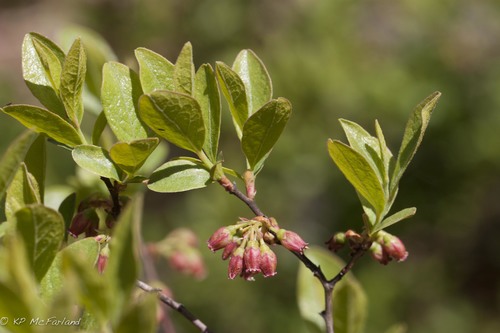


Black Huckleberry
gaylussacia baccata
The Black Huckleberry (Gaylussacia baccata) is a resilient, deciduous shrub native to eastern North America. Renowned for its sweet, dark edible berries, this plant plays an essential role in its forest ecosystems by providing vital nourishment to a vast array of wildlife, from songbirds to black bears. It thrives in acidic, nutrient-poor soils, often forming dense colonies through underground rhizomes. Beyond its ecological value, the Black Huckleberry is highly celebrated by foragers who prize its deep purple to black fruits, which contain tiny, crunchy seeds that distinguish them from true blueberries.
Habitat: Found in dry or sandy acidic soils, open woodlands, rocky slopes, and pine barrens across eastern North America.
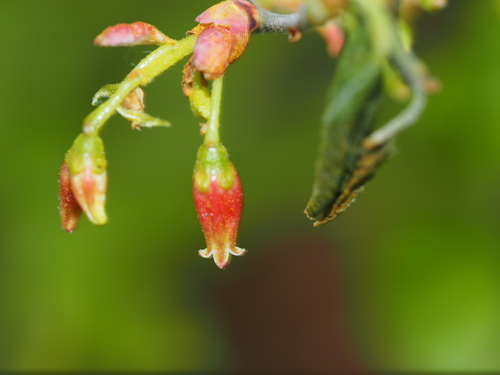
Growing up to 1 meter tall, this woody shrub features yellowish-green to reddish-brown twigs and oval, alternate leaves with smooth margins. A key identification feature is the presence of glistening, resinous golden-yellow dots on both the upper and lower surfaces of the leaves, which can be seen under a magnifying glass. In spring, the plant bears drooping, bell-shaped flowers that range in color from greenish-pink to deep red. These are followed in late summer by clusters of glossy, dark black, spherical berries roughly 6 to 8 millimeters in diameter.
Category
PlantsRarity
Common
Danger
1/5 · Very low
Snaps
7
Black Huckleberry is highly fire-resistant; fire actually stimulates its rhizomes to sprout, often leading to a bumper crop of berries the following year.
The resin dots on the leaves will actually rub off onto paper, leaving a yellow stain that early botanists used for identification.
Unlike true blueberries, huckleberries have exactly ten hard, seed-like nutlets inside each berry, giving them a distinct crunch.
The leaves are covered in tiny, yellowish resin glands that help reduce water loss and protect the plant from intense solar radiation in dry, open habitats.
It forms extensive clonal colonies via underground rhizomes, allowing it to quickly resprout and dominate the understory after forest fires.
This species thrives in highly acidic, nutrient-depleted soils where many other plants fail, utilizing symbiotic mycorrhizal fungi to absorb nutrients.
As a photoautotrophic plant, the Black Huckleberry generates its own energy through photosynthesis, utilizing sunlight, carbon dioxide, and water while absorbing soil nutrients.
Bombus bimaculatus
Bumblebees visit the bell-shaped flowers in spring to collect nectar and pollen, acting as primary pollinators.
Ursus americanus
Black bears consume large quantities of the ripe berries in late summer to build fat reserves for winter.
Paonias astylus
The caterpillars of this specialized moth feed on the foliage of huckleberries and related plants.
No trait badges are assigned for this object yet.
No aliases listed yet.
Collections for this object will appear here as more themes are added.
Danger
1/5 · Very low
No special safety notes yet.
The easiest way to identify Black Huckleberry is to use the Snappit nature identifier app.
30-150 cm
20-100 years
As a photoautotrophic plant, the Black Huckleberry generates its own energy through photosynthesis, utilizing sunlight, carbon dioxide, and water while absorbing soil nutrients.
Found in dry or sandy acidic soils, open woodlands, rocky slopes, and pine barrens across eastern North America.
Zoom in to split clusters and explore where this object has been snapped.
May 28, 2026
Days Ferry Historic DistrictPhoto attribution
(c) Clay Gibbons, some rights reserved (CC BY)
License: CC BY 4.0 ↗
Image may be shown cropped inside the card frame.

Maryland, US
You might spot American Cancer-Root and Rue Anemone.
View guide →

US
You might spot Pink Lady's Slipper and Canada Mayflower.
View guide →

New York, US
You might spot Bald Eagle, Common Eastern Bumble Bee, and Red-Tailed Hawk.
View guide →

Maine, US
You might spot Rugosa Rose and European Green Crab.
View guide →

Kentucky, US
You might spot Multiflora Rose, Eastern Newt, and American Beech.
View guide →

New Hampshire, US
You might spot Eastern Newt, Common Loon, and Hickory Tussock Moth.
View guide →
Take the discovery with you
Snap it with Snappit to identify it, learn what makes it special, and add the discovery to your collection.











.jpg&width=800)



_001.jpg&width=800)




