
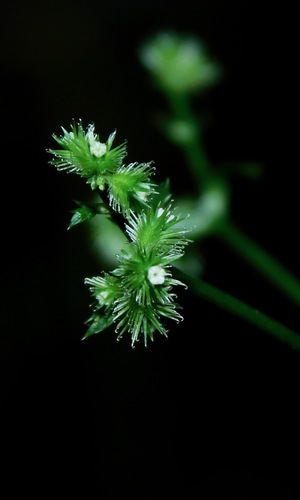


Black Snakeroot
sanicula canadensis
Black Snakeroot (Sanicula canadensis) is a fascinating perennial herb belonging to the carrot family (Apiaceae), native to the woodlands of eastern North America. While often overlooked, this modest plant plays a quiet but important role in its forest ecosystem. It's recognized by its distinctive burr-like fruits, a clever adaptation for seed dispersal, which allows it to hitch rides on passing animals. The plant's ability to thrive in the dappled light of the forest understory makes it a resilient member of many woodland communities, often found growing amidst a diverse array of other native flora.
Habitat: Found in various types of woodlands, deciduous forests, forest edges, clearings, and disturbed areas, preferring rich, moist to dry soils and partial to full shade.
Black Snakeroot typically grows 30-90 cm tall, featuring an erect, slender stem. Its basal leaves are palmately compound, deeply lobed, and often wither by the time of flowering. Stem leaves are alternate, smaller, and less divided. The small, inconspicuous flowers are greenish-white to white, clustered in small, irregular umbels. The most striking visual identifier is its unique fruit: small, globose to ovoid burrs densely covered with hooked bristles, which develop after flowering and are responsible for its 'sticky' nature.
Category
PlantsRarity
Common
Danger
1/5 · Very low
Snaps
Be the first to snap!
Despite its common name, Black Snakeroot is not related to the White Snakeroot (Ageratina altissima), which is highly toxic to livestock and humans.
Historically, various Indigenous peoples used parts of Black Snakeroot for medicinal purposes, particularly in poultices or infusions for skin ailments or fevers, although its efficacy is not scientifically proven.
It is part of the carrot family (Apiaceae), a diverse group that includes culinary plants like carrots, parsley, and dill, but also toxic plants like poison hemlock.
The 'burrs' of Black Snakeroot are a prime example of zoochory, where seeds are dispersed by animals, often hitchhiking on fur or feathers.
The fruits of Black Snakeroot are covered in stiff, hooked bristles that readily cling to animal fur or human clothing, facilitating effective long-distance seed dispersal.
This plant is well-adapted to the low-light conditions of the forest understory, efficiently utilizing the dappled sunlight that penetrates the canopy for photosynthesis.
Its small, clustered flowers attract a variety of small pollinators, including flies and tiny bees, ensuring successful reproduction even with subtle floral displays.
As an autotrophic plant, Black Snakeroot produces its own food through photosynthesis. It converts sunlight, water, and carbon dioxide into sugars, while absorbing essential minerals and nutrients from the soil.
Ceratina calcarata
Pollinator for its small flowers

Odocoileus virginianus
Carries and disperses seeds via fur

Sylvilagus floridanus
May occasionally browse foliage, but not a primary food source
Glomeromycota species
Interacts with roots for nutrient exchange
No trait badges are assigned for this object yet.
No aliases listed yet.
Collections for this object will appear here as more themes are added.
Danger
1/5 · Very low
No special safety notes yet.
Start with the whole plant, then compare leaf arrangement, leaf edges, stems and any flowers or fruit. Opposite leaves grow in pairs; alternate leaves come one at a time along the stem. These details tell you far more together than a single green leaf does. Plant Identifier: upload a photo and compare the visible details.
30-90 cm
0.01-0.05 kg
2-5 years
As an autotrophic plant, Black Snakeroot produces its own food through photosynthesis. It converts sunlight, water, and carbon dioxide into sugars, while absorbing essential minerals and nutrients from the soil.
Found in various types of woodlands, deciduous forests, forest edges, clearings, and disturbed areas, preferring rich, moist to dry soils and partial to full shade.
Absorption
Zoom in to split clusters and explore where this object has been snapped.
Recent snaps will appear here as new observations are added.
Take the discovery with you
Snap it with Snappit to identify it, learn what makes it special, and add the discovery to your collection.


















