


Black-Stemmed Spleenwort
asplenium resiliens
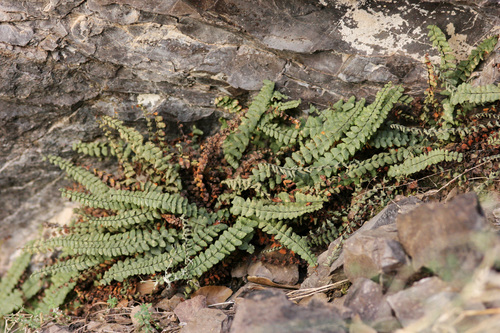
The Black-Stemmed Spleenwort (Asplenium resiliens) is a small, resilient evergreen fern that adds delicate beauty to harsh, rocky landscapes. Commonly found clinging to limestone crevices, cliffs, and sinkholes, this hardy little plant thrives where few others can, utilizing its highly specialized root system to anchor itself firmly into bare stone. Its striking contrast of dark, purplish-black stems against vibrant green foliage makes it a favorite among native plant enthusiasts and rock-gardeners. Beyond its aesthetic appeal, this fern plays an important role in localized rock ecosystems. By colonizing bare stone, it helps trap organic matter, contributing to early soil formation and creating micro-habitats for tiny invertebrates and mosses. It is highly drought-tolerant, entering a state of dormancy during dry spells and springing back to life when moisture returns.
Habitat: Typically found growing in moist to dry crevices of limestone cliffs, ledges, sinkholes, and rocky deciduous woodlands.
This small fern features narrow, once-pinnate fronds that typically grow 10 to 30 centimeters in length. The most distinguishing characteristic is its stiff, shiny, dark purplish-black stipe (stem) and rachis, which provide a stark contrast to the small, opposite, oblong leaflets (pinnae). The pinnae are light to medium green, slightly asymmetric at the base, and have smooth or slightly wavy margins. On the undersides of mature fertile fronds, one can find herringbone-patterned clusters of spore-producing structures called sori.
Category
PlantsRarity
Common
Danger
1/5 · Very low
Snaps
Be the first to snap!
Its dark, ebony-colored stems are extremely tough and can remain standing long after the green leaflets have withered away.
The species name 'resiliens' translates to 'resilient' or 'springing back', a nod to the fern's incredible ability to revive after severe droughts.
Unlike many ferns that prefer acidic soils, this species is a calciphile, meaning it actively craves and thrives in highly alkaline, calcium-rich environments.
It can survive extreme dry periods by curling its fronds and suspending metabolic activity, rapidly rehydrating and recovering when water becomes available.
Features specialized, highly fibrous roots that exude mild organic acids to etch into rock crevices, securing a firm grip on sheer stone walls.
Specially adapted to thrive in alkaline, calcium-rich soils and limestone substrates that would stunt or kill other acid-loving fern species.
As a photoautotrophic plant, it produces its own energy through photosynthesis, utilizing sunlight, carbon dioxide, and water while absorbing essential minerals like calcium from its limestone substrate.

Odocoileus virginianus
Occasionally browsed by herbivores when other forage is scarce during the winter months.
Anomodon attenuatus
Shares the same rocky limestone micro-habitat, competing for space and moisture in rock crevices.
Adiantum capillus-veneris
Competes for moisture and rooting space in damp, calcareous rock crevices.
No trait badges are assigned for this object yet.
No aliases listed yet.
Collections for this object will appear here as more themes are added.
Danger
1/5 · Very low
No special safety notes yet.
Compare frond shape, how the leaflets are arranged, the stalk, and any spore clusters you can see. A single detached leaflet often hides the plant's overall growth pattern. Fern Identifier: upload a photo and compare the visible details.
10-30 cm
5-15 years
As a photoautotrophic plant, it produces its own energy through photosynthesis, utilizing sunlight, carbon dioxide, and water while absorbing essential minerals like calcium from its limestone substrate.
Typically found growing in moist to dry crevices of limestone cliffs, ledges, sinkholes, and rocky deciduous woodlands.
Zoom in to split clusters and explore where this object has been snapped.
Recent snaps will appear here as new observations are added.
Take the discovery with you
Snap it with Snappit to identify it, learn what makes it special, and add the discovery to your collection.


















