

Blue Mountain Prairie Clover
dalea ornata
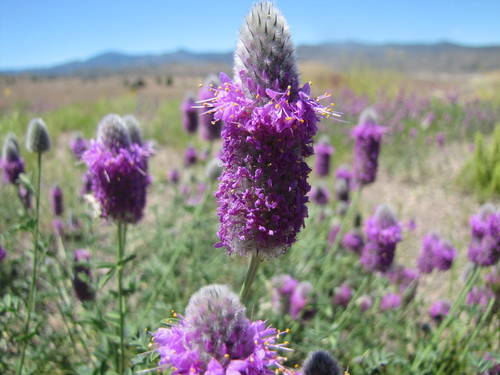
The Blue Mountain Prairie Clover (Dalea ornata) is an eye-catching perennial wildflower native to the arid landscapes, sagebrush steppes, and rocky canyons of the Pacific Northwest. Part of the legume family, this beautiful plant produces vibrant, rose-purple flower spikes that rise gracefully above its textured, green foliage. Beyond its aesthetic appeal, it serves as an ecological anchor, stabilizing dry soils with its extensive taproot system and enriching the surrounding habitat through nitrogen fixation.
Habitat: Typically found on dry, sandy, or gravelly soils within sagebrush steppes, basalt slopes, and open ponderosa pine woodlands.
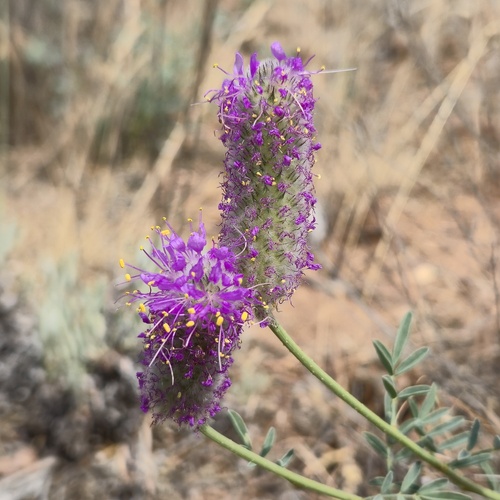
This species forms upright clumps between 15 to 50 centimeters tall, featuring compound leaves with 5 to 7 gland-dotted, lance-shaped leaflets. Its most striking feature is the dense, cone-shaped flower spike at the tip of each stem, packed with tiny pink-purple flowers that are supported by distinctly hairy, fuzzy calyces, giving the spike a soft, textured appearance.
Category
PlantsRarity
Common
Danger
1/5 · Very low
Snaps
6
Ecologists highly prize this plant for restoring degraded rangelands because its deep roots are excellent at preventing soil erosion.
Its fuzzy flower spikes strongly resemble colorful, miniature bottle-brushes blooming in the desert.
The name 'Blue Mountain' does not refer to the color of its flowers, but rather the Blue Mountains region of Oregon and Washington where it is natively found.
Enriches impoverished soils by harboring symbiotic root bacteria that convert atmospheric nitrogen into usable plant nutrients.
Utilizes a deep, robust taproot system to access moisture stored deep within the arid, rocky earth during hot summer months.
Features gland-dotted foliage that releases bitter chemical compounds to discourage grazing by generalist herbivores.
As a primary producer, this plant utilizes photosynthesis to generate energy from sunlight, carbon dioxide, and water while absorbing essential soil nutrients.
Centrocercus urophasianus
The foliage and protein-rich seeds are consumed as food by native wildlife.
.jpg&width=800)
Megachile rotundata
Native bees visit the showy flower spikes to collect pollen and nectar, facilitating pollination.
Rhizobium leguminosarum
Symbiotic bacteria colonize the roots, providing nitrogen to the plant in exchange for carbohydrates.
No trait badges are assigned for this object yet.
No aliases listed yet.
Collections for this object will appear here as more themes are added.
Danger
1/5 · Very low
No special safety notes yet.
The easiest way to identify Blue Mountain Prairie Clover is to use the Snappit nature identifier app.
15-50 cm
3-10 years
As a primary producer, this plant utilizes photosynthesis to generate energy from sunlight, carbon dioxide, and water while absorbing essential soil nutrients.
Typically found on dry, sandy, or gravelly soils within sagebrush steppes, basalt slopes, and open ponderosa pine woodlands.
Zoom in to split clusters and explore where this object has been snapped.
Jun 7, 2026
Painted HillsPhoto attribution
(c) John Clonce, some rights reserved (CC BY)
License: CC BY 4.0 ↗
Image may be shown cropped inside the card frame.
Take the discovery with you
Snap it with Snappit to identify it, learn what makes it special, and add the discovery to your collection.












.jpg&width=800)



_001.jpg&width=800)




