

Blue-Spotted Cylindrical Skink
chalcides coeruleopunctatus
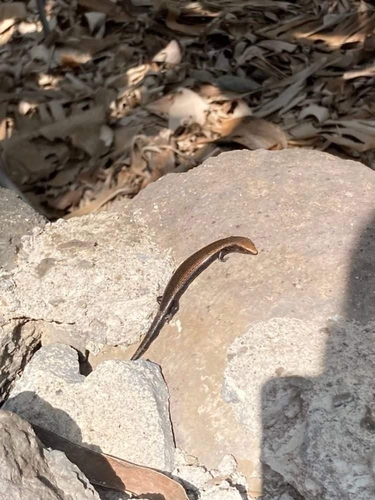
The Blue-Spotted Cylindrical Skink (Chalcides coeruleopunctatus) is a remarkable reptile endemic to the Canary Islands, specifically thriving on La Gomera and El Hierro. Highly adapted to a subterranean and leaf-litter lifestyle, this skink has evolved a long, snake-like body paired with surprisingly small limbs. Despite its delicate appearance, it is an agile and highly capable hunter, darting quickly under rocks and through dense vegetation to ambush small insects. What truly sets this species apart is the striking visual feature that gives it its name: a dusting of iridescent blue specks along its glossy, dark flanks. As a viviparous species, it gives birth to fully formed live young rather than laying eggs, a fascinating adaptation that helps protect its offspring in the varied microclimates of its island home.
Habitat: Typically found in the temperate shrublands, rocky slopes, agricultural terracing, and leaf litter of La Gomera and El Hierro in the Canary Islands.
This skink possesses a highly elongated, cylindrical body covered in smooth, glossy scales that range in color from olive-brown to dark bronze. Its most defining field mark is the presence of bright, metallic blue flecks or spots scattered along its sides and sometimes on its back. Its limbs are greatly reduced, appearing almost disproportionately small for its body size, and it has a relatively blunt head and a long, tapering tail that seamlessly blends into its torso.
Category
ReptilesRarity
Common
Danger
1/5 · Very low
Snaps
Be the first to snap!
Because it lives on islands with varied elevations and microclimates, giving birth to live young allows the mother to actively seek out optimal temperatures for her developing babies.
Even though it has four legs, the limbs are so short that when it needs to move quickly, it simply folds them against its sides and slithers like a snake.
It is a true island specialist, found nowhere else in the world except the rugged terrains of La Gomera and El Hierro in the Canary archipelago.
The metallic blue specks that give the Blue-Spotted Cylindrical Skink its name are highly iridescent and reflect beautifully in direct sunlight.
Due to its tiny limbs, it relies heavily on lateral undulations, moving smoothly and rapidly like a snake when navigating through loose soil and dense vegetation.
When grabbed by a predator, it can voluntarily detach its tail to create a wriggling distraction, later regenerating a new, albeit shorter, tail.
It bypasses the vulnerable egg stage entirely by giving birth to live young, protecting the developing embryos internally until they are fully formed.
The skink feeds predominantly on a diverse array of small terrestrial invertebrates found in leaf litter and under rocks.
Age differences: Juveniles consume smaller, softer-bodied insects like springtails and aphids before graduating to harder-shelled beetles and spiders as adults.
Hogna radiata
Preys on these small, abundant ground-dwelling spiders.
Falco tinnunculus
Frequently hunted by this common avian predator across the Canary Islands.

Felis catus
Introduced species that poses a significant predation threat to local skink populations.
No trait badges are assigned for this object yet.
No aliases listed yet.
Collections for this object will appear here as more themes are added.
Danger
1/5 · Very low
No special safety notes yet.
Compare toes, scales, head shape, crests and tail proportions. Many lizards can drop and regrow their tails, so a short tail isn't always a species trait. Lizard Identifier: upload a photo and compare the visible details.
10-16 cm
0.005-0.015 kg
4-8 years
The skink feeds predominantly on a diverse array of small terrestrial invertebrates found in leaf litter and under rocks.
Typically found in the temperate shrublands, rocky slopes, agricultural terracing, and leaf litter of La Gomera and El Hierro in the Canary Islands.
Foraging
2-5
Zoom in to split clusters and explore where this object has been snapped.
Recent snaps will appear here as new observations are added.
Take the discovery with you
Snap it with Snappit to identify it, learn what makes it special, and add the discovery to your collection.