





Boisduval's Blue
Icaricia icarioides
Boisduval's Blue is a small, beautiful butterfly with bright blue wings. They flit around flowers and are often seen in sunny spots, making them a lovely sight in nature.
Habitat: Grasslands
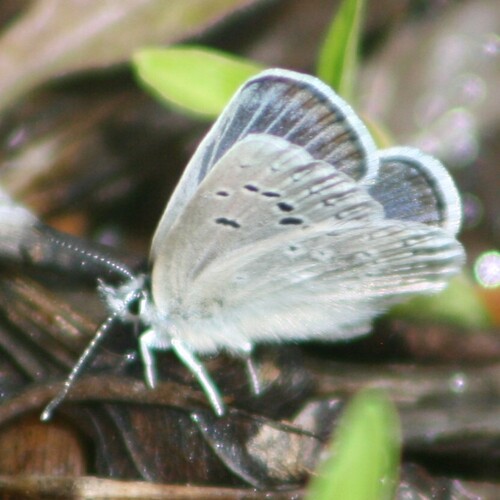
The Boisduval's Blue is a small butterfly with males sporting iridescent blue upperwings bordered thinly in black. Females vary from mostly blue to entirely brown with some blue scaling. Their undersides are pale gray or brownish, marked with distinctive black spots encircled in white.
Category
InsectsRarity
Common
Danger
1/5 · Very low
Snaps
6
Caterpillars offer ants a sugary treat called honeydew for protection!
Males are brilliant iridescent blue, but females are often duller brown!
Some Boisduval's Blues live high in chilly mountain meadows!
They only lay their eggs on specific types of lupine plants!
Boisduval's Blue has spotted undersides that help them blend with foliage, making it harder for predators to spot them.
Boisduval's Blue caterpillars can only eat specific lupine plants, having evolved to process these unique leaves.
Boisduval's Blue males have iridescent blue scales that reflect light to create a dazzling display, attracting mates.
Boisduval's Blue caterpillars produce sweet honeydew, which attracts ants that protect them from predators.
Adults sip flower nectar; caterpillars munch on specific lupine leaves.
Age differences: Larvae eat lupine leaves; adults primarily drink nectar.
Lupinus polyphyllus
Host plant for caterpillars
Formica fusca
Ants protect caterpillars for honeydew

Pica hudsonia
Birds prey on butterflies
.jpg&width=800)
Lupinus arboreus
Adults help fertilize flowers
Colorful describes organisms or objects displaying a wide range of bright and distinct colors.
Grassland habitats are terrestrial biomes dominated by grasses and herbaceous plants, supporting a variety of grazing animals.
This trait characterizes organisms whose diet consists entirely or primarily of plant material.
Describes plants that are particularly attractive and beneficial to a wide range of pollinating organisms.

Diurnal animals are primarily active during daylight hours, typically resting or sleeping at night.

Describes organisms that transfer pollen, enabling the fertilization and reproduction of plants.
No aliases listed yet.
Danger
1/5 · Very low
Always watch butterflies from a distance so you don't scare them away.
The easiest way to identify Boisduval's Blue is to use the Snappit nature identifier app.
25-35 mm
10-15 mm
7-14 days
10-20 km/h
Adults sip flower nectar; caterpillars munch on specific lupine leaves.
Grasslands
Foraging
Zoom in to split clusters and explore where this object has been snapped.
May 24, 2026
James Cant RanchPhoto attribution
(c) John Clonce, some rights reserved (CC BY)
License: CC BY 4.0 ↗
Image may be shown cropped inside the card frame.

Montana, US
You might spot Great Blanketflower and Seven-Spotted Lady Beetle.
View guide →

Wyoming, US
You might spot Elk, American White Pelican, and Arrowleaf Balsamroot.
View guide →

Oregon, US
You might spot Mule Deer, Song Sparrow, and Northern Yellow Warbler.
View guide →

Montana, US
You might spot Field Crescent, Thimbleberry, and Baker's Mariposa Lily.
View guide →

Oregon, US
You might spot Rough-Skinned Newt and Pacific Banana Slug.
View guide →

Oregon, US
You might spot Balkan Toadflax, Big Sagebrush, and Western Juniper.
View guide →
Take the discovery with you
Snap it with Snappit to identify it, learn what makes it special, and add the discovery to your collection.






.jpg&width=800)



