





Bos grunniens
Bos grunniens
The yak is a strong, furry animal that lives in the mountains. They have long hair to keep warm and are great at carrying heavy loads for people.
Habitat: Mountain regions
The Bos grunniens is a large, sturdy bovid with a dense, shaggy coat of dark brown to black fur that nearly reaches the ground. It has a distinctive hump on its shoulders and a short tail with a bushy tuft. Both sexes have long, upward-curving horns.
Category
MammalsRarity
Common
Danger
3/5 · Moderate
Snaps
Be the first to snap!
Their long, coarse outer hair is shed annually and can be collected to make ropes!
They roll in the snow to cool off and remove parasites from their thick fur!
Wild yaks communicate with grunts, never mooing like cows!
Yaks can survive temperatures as low as -40°C thanks to their incredible adaptations!
Bos grunniens has extra-large lungs and specialized blood that helps them thrive in thin air, even at extreme mountain altitudes.
Bos grunniens has a thick double-layered coat of shaggy fur that helps them stay warm against freezing winds and snow.
Bos grunniens has strong legs and broad hooves with sharp rims that help them navigate steep, rocky slopes with ease.
Wild yaks are herbivores that graze on tough grasses and hardy plants found in harsh mountain environments.
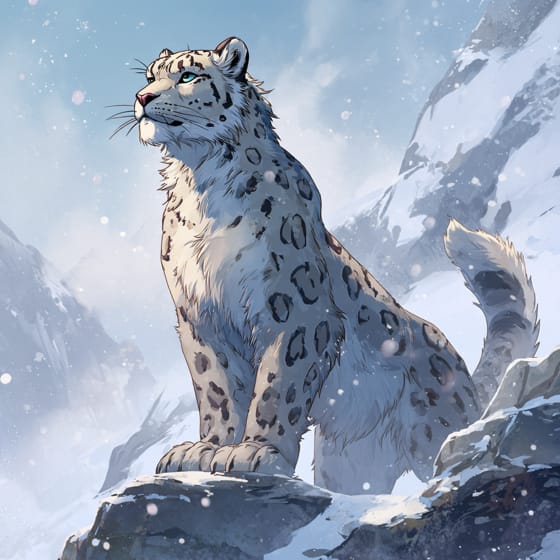
Panthera uncia
A primary predator of young or vulnerable yaks.
Canis lupus
Wolves often hunt yaks in packs, targeting weaker individuals.
Gyps himalayensis
Scavenges on the carcasses of yaks that have died.
Furry describes animals possessing a dense covering of soft hair or fur.
Social animals live in organized groups, cooperating for survival benefits such as foraging, defense, and raising offspring.
Characterized by having one or more hard, permanent, pointed projections on the head.
This trait characterizes organisms whose diet consists entirely or primarily of plant material.

This habitat trait identifies species found in mountainous regions, characterized by high elevation, steep slopes, and varying climate zones.

This trait characterizes organisms with an exceptionally long lifespan compared to others of their kind.

Diurnal animals are primarily active during daylight hours, typically resting or sleeping at night.
Danger
3/5 · Moderate
Always keep a safe distance from yaks, as they can be big and strong.
The easiest way to identify Bos grunniens is to use the Snappit nature identifier app.
250-330 cm
300-1000 kg
15-25 years
40 km/h
Wild yaks are herbivores that graze on tough grasses and hardy plants found in harsh mountain environments.
Mountain regions
Grazing
Zoom in to split clusters and explore where this object has been snapped.
Recent snaps will appear here as new observations are added.
Take the discovery with you
Snap it with Snappit to identify it, learn what makes it special, and add the discovery to your collection.




.jpg&width=800)


.JPG&width=800)


.jpg&width=800)
