.jpg&width=800)





broad-leaved sweet pea
Lathyrus latifolius
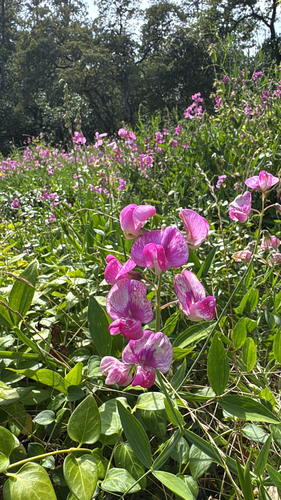
The broad-leaved sweet pea is a lovely flower that grows in many gardens. It has big, green leaves and colorful flowers that can be pink, purple, or white. These flowers smell sweet and attract butterflies!
Habitat: Urban areas
The broad-leaved sweet pea has vibrant clusters of pink, purple, or white flowers on long, winged stems. Its most distinctive feature is its pairs of wide, flattened leaves, which give the plant its name. These features help it climb and sprawl gracefully.
Category
PlantsRarity
Common
Danger
1/5 · Very low
Snaps
28
Even though it's called 'sweet pea,' its seeds are not for eating and should be avoided!
Its scientific name, Lathyrus latifolius, means 'broad-leaved vetchling' in Latin!
This tough perennial can live for many years, often growing back bigger and stronger each spring!
Unlike many sweet peas, the broad-leaved variety has little to no fragrance, letting its vibrant colors shine!
Broad-leaved sweet pea can grow strong tendrils that wrap around supports, helping it climb high to reach more sunlight.
This plant has special bacteria in its roots that help it enrich the soil with important nutrients, aiding its own growth.
Broad-leaved sweet pea can grow deep, tough roots, helping it survive dry spells and grow back year after year.
Bombus terrestris
Visits flowers for nectar and pollen
Apis mellifera
Feeds on flower nectar and pollen
Rhizobium leguminosarum
Lives in roots, fixes nitrogen for plant
Deroceras reticulatum
May feed on leaves and young shoots
Deciduous plants periodically shed all their leaves, typically during autumn or dry seasons.
Flowering plants are any plants that produce flowers as part of their reproductive cycle.
Summer blooming plants produce their flowers during the summer season, often providing vibrant color when many other plants have finished.
Everblooming plants produce flowers continuously or in repeated flushes over a long period.

Fragrant flowers emit a pleasant aroma, often to attract pollinators or for defense.

Colorful describes organisms or objects displaying a wide range of bright and distinct colors.

Describes plants that are particularly attractive and beneficial to a wide range of pollinating organisms.

This habitat trait indicates species that can coexist with humans in urban and suburban environments, utilizing man-made structures and green spaces.
No aliases listed yet.
Danger
1/5 · Very low
Always check with an adult before touching or picking flowers.
The easiest way to identify broad-leaved sweet pea is to use the Snappit nature identifier app.
150-300 cm
60-180 cm
2-4 cm
Summer
No
Mild
Perennial
Zoom in to split clusters and explore where this object has been snapped.
Jun 2, 2026
Old Auburn Historic DistrictPhoto attribution
(c) Gregory Wada, some rights reserved (CC BY)
License: CC BY 4.0 ↗
Image may be shown cropped inside the card frame.

New Jersey, US
You might spot Garlic Mustard, Sensitive Fern, and Common Mugwort.
View guide →

Alabama, US
You might spot Elf Orpine, Canada Goose, and Leatherleaf Mahonia.
View guide →

California, US
You might spot Sequoia, California Newt, and Pacific Dogwood.
View guide →

Oregon, US
You might spot Duck, Pacific Trillium, and Wood Duck.
View guide →

Alabama, US
You might spot Elf Orpine, Canada Goose, and Great Blue Heron.
View guide →

Ohio, US
You might spot Brown-Belted Bumble Bee and Eastern Carpenter Bee.
View guide →
Take the discovery with you
Snap it with Snappit to identify it, learn what makes it special, and add the discovery to your collection.







.jpg&width=800)


_001.jpg&width=800)




