

Bumblebee Millipede
anadenobolus monilicornis
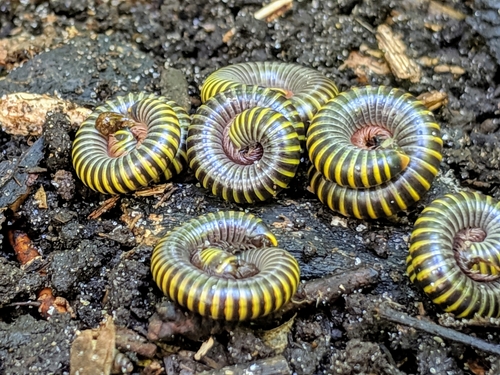
The Bumblebee Millipede (Anadenobolus monilicornis) is a striking and beautifully patterned arthropod native to the Caribbean. Instantly recognizable by its vivid alternating yellow and dark banding, this small millipede has become a popular subject of fascination among nature enthusiasts and invertebrate keepers alike. Unlike its namesake insect, the Bumblebee Millipede is entirely wingless, slow-moving, and cannot sting; its coloration is simply a clever bluff to warn away predators. Beneath the forest canopy and amidst urban gardens in its introduced ranges, such as the southeastern United States, this millipede works tirelessly to break down decaying organic matter. By consuming fallen leaves and rotting wood, it recycles nutrients back into the soil ecosystem, acting as a miniature, natural fertilizer factory. Their docility, ecological importance, and distinct aposematic colors make them a captivating find for any macro photographer or curious nature spotter.
Habitat: Found in warm, humid tropical and subtropical environments, primarily dwelling in damp leaf litter, rich soil, and under decaying logs.
This millipede has a smooth, cylindrical body composed of numerous hard segments, typically reaching 4 to 7 centimeters in length. Its most defining feature is the striking pattern of alternating vibrant yellow and deep black or dark brown bands wrapping around each segment, strongly resembling a bumblebee. The numerous, tiny legs and short antennae provide a subtle contrast to the body, often appearing in pale pink, maroon, or reddish hues. When threatened, it tightly coils its body into a perfect, flat spiral, hiding its head and vulnerable underbelly while prominently displaying its bright warning bands.
Category
AnimalRarity
Common
Danger
1/5 · Very low
Snaps
2
Despite its warning colors and name, the Bumblebee Millipede cannot sting and is completely harmless, relying entirely on visual bluffing and mild secretions to stay safe.
Newly hatched bumblebee millipedes only have a few body segments and three pairs of legs, adding more segments and legs with each successive molt as they age.
The word 'millipede' translates to 'thousand feet', but no known Bumblebee Millipede actually has 1,000 legs—they typically have between 100 and 200.
When they molt to accommodate their growing bodies, they often consume their old exoskeleton to recover valuable nutrients like calcium.
When threatened or disturbed, it tightly rolls its cylindrical body into a flat spiral, protecting its head and soft underside with its hard outer exoskeleton.
It can secrete a foul-tasting, mildly toxic defensive fluid from specialized glands along its body to deter predators, which can temporarily stain human skin a brownish hue.
Possesses a specialized digestive system rich in symbiotic bacteria that efficiently breaks down tough, decaying plant cellulose, returning vital nutrients to the soil.
The Bumblebee Millipede feeds almost exclusively on decaying plant matter, breaking down dead vegetation and turning it into fertile soil.
Age differences: Nymphs consume softer, finer detritus and occasionally the frass (feces) of adult millipedes to acquire necessary gut bacteria for digestion.

Porcellio scaber
Competes for decaying leaf litter resources in humid micro-habitats.

Rhinella marina
Preyed upon by opportunistic ground-dwelling amphibians that can tolerate its chemical defenses.

Quercus virginiana
Actively breaks down leaf litter dropped by prominent regional trees.
No trait badges are assigned for this object yet.
No aliases listed yet.
Collections for this object will appear here as more themes are added.
Danger
1/5 · Very low
No special safety notes yet.
Start with body shape, legs or fins, fur, feathers or scales, and standout markings. Then weigh size, habitat and where you saw it. Young animals and seasonal coats can look very different from familiar adults. Animal Identifier: upload a photo and compare the visible details.
4-7 cm
0.001-0.003 kg
2-5 years
The Bumblebee Millipede feeds almost exclusively on decaying plant matter, breaking down dead vegetation and turning it into fertile soil.
Found in warm, humid tropical and subtropical environments, primarily dwelling in damp leaf litter, rich soil, and under decaying logs.
Foraging
20-100
Zoom in to split clusters and explore where this object has been snapped.

Indiana, US
You might spot Eastern Fox Squirrel, Duck, and Canada Goose.
View guide →

Florida, US
You might spot Crested Anole, Brown Anole, and Peters's Rock Agama.
View guide →
Take the discovery with you
Snap it with Snappit to identify it, learn what makes it special, and add the discovery to your collection.