


Buprestoidea
buprestoidea
Buprestoidea, commonly known as jewel beetles or metallic wood-boring beetles, represent a diverse and often spectacularly colored superfamily of beetles. These insects are renowned for their striking iridescent exoskeletons, which shimmer with metallic greens, blues, coppers, and reds, making them highly prized by collectors. While adults are typically found on flowers or tree trunks, their larvae are notable for being internal wood-borers, often living hidden within trees for several years. This superfamily includes species that are both vital to ecosystem health by breaking down deadwood and, in some cases, significant pests of timber and ornamental trees.
Habitat: Found globally in a wide range of woody habitats, from dense forests and woodlands to orchards, savannas, and even suburban gardens with mature trees.
Jewel beetles are characterized by their often flattened, elongated, or boat-shaped bodies, which can range in size from a few millimeters to over 10 centimeters. Their most distinctive feature is their brilliant, often iridescent, metallic coloration, which can appear to shift with the angle of light. Common colors include emerald green, sapphire blue, ruby red, and coppery bronze. They possess short, serrated antennae and large, prominent eyes. Their hard, chitinous forewings (elytra) cover a pair of membranous hindwings used for flight, and often display intricate patterns or sculpturing.
Category
InsectsRarity
Common
Danger
1/5 · Very low
Snaps
Be the first to snap!
Certain large jewel beetles from Southeast Asia have historically been used in jewelry and decorative arts due to their brilliant, metallic wing casings.
Many jewel beetle species are attracted to stressed or freshly cut trees because the chemicals released by these trees signal an ideal environment for their wood-boring larvae.
Some jewel beetle species are significant agricultural and forestry pests, with their larvae causing extensive damage to timber and fruit trees.
The larvae of some jewel beetle species can live for decades inside wood before emerging, with one record of a beetle emerging from furniture after 51 years!
The larvae of Buprestoidea are primarily xylophagous, meaning they bore into and feed on the wood of trees, both living and dead. This ability allows them to develop hidden from many predators, often creating extensive tunnels within the cambium or heartwood.
Their famously brilliant, metallic exoskeletons are not due to pigments but structural coloration, which helps them camouflage effectively against bark and leaves by scattering light. This iridescence also serves as a warning to predators.
Certain species, particularly those attracted to burnt wood, possess specialized infrared receptors that can detect forest fires from many kilometers away. This allows them to quickly locate recently burned trees for oviposition, as these provide ideal larval food sources.
Adult jewel beetles primarily feed on pollen, nectar, or foliage of various plants. Their larvae are strictly wood-borers, consuming the wood of host trees, which can be either living, stressed, or dead depending on the species.
Age differences: Larvae consume internal wood tissues, while adults feed on external plant parts like pollen, nectar, or foliage.
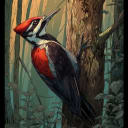
Picidae
Predation on larvae
Quercus
Larval host plant
Braconidae
Parasitoid of larvae

Muscicapidae
Predation on adults
Colorful describes organisms or objects displaying a wide range of bright and distinct colors.
This trait characterizes organisms whose diet consists entirely or primarily of plant material.
Describes organisms that break down dead organic material, recycling nutrients back into the ecosystem.
Forest habitats are terrestrial environments dominated by dense tree cover, supporting a high diversity of plant and animal life.
Diurnal animals are primarily active during daylight hours, typically resting or sleeping at night.
Describes a species whose presence and role have a disproportionately large effect on its environment.
This trait identifies organisms that exhibit exceptional swiftness in movement for hunting, escape, or travel.
Pertaining to organisms that emit light through bioluminescence or fluorescence.
Describes organisms that transfer pollen, enabling the fertilization and reproduction of plants.
No aliases listed yet.
Collections for this object will appear here as more themes are added.
Danger
1/5 · Very low
No special safety notes yet.
Look for hard wing covers meeting in a line down the back, then compare the antennae, body shape, legs and markings. Metallic colors shift a lot with lighting. Beetle Identifier: upload a photo and compare the visible details.
0-10 cm
0-15 cm
0.0001-0.005 kg
0-3 years
Adult jewel beetles primarily feed on pollen, nectar, or foliage of various plants. Their larvae are strictly wood-borers, consuming the wood of host trees, which can be either living, stressed, or dead depending on the species.
Found globally in a wide range of woody habitats, from dense forests and woodlands to orchards, savannas, and even suburban gardens with mature trees.
Foraging
Zoom in to split clusters and explore where this object has been snapped.
Recent snaps will appear here as new observations are added.
Take the discovery with you
Snap it with Snappit to identify it, learn what makes it special, and add the discovery to your collection.