





California manroot
Marah fabacea
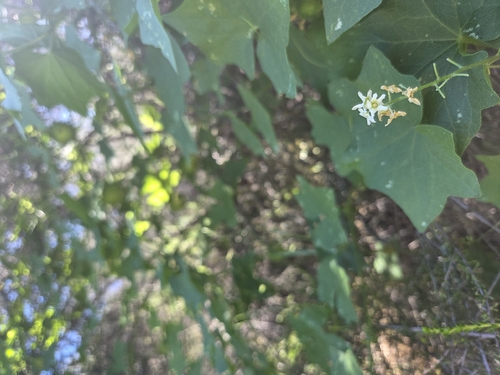
California manroot is a unique plant with big, heart-shaped leaves and long, twisting vines. It grows in sunny places and can climb over other plants, making it look like a green blanket in nature.
Habitat: Coastal areas
The California manroot is a fast-growing vine with large, deeply lobed green leaves. It produces clusters of small, white to creamy-yellow flowers. Its most striking feature is the round to oval fruit, covered in soft, yellowish-green spines.
Category
PlantsRarity
Common
Danger
2/5 · Low
Snaps
1
Its enormous root can grow over 200 pounds, hiding underground!
Its speedy vines can grow up to a foot in a single day!
Native Americans once used parts of this plant for traditional medicine!
This plant can sprout new vines incredibly fast after winter rains!
California manroot has a massive underground tuber that stores water, helping it survive long, dry summers.
California manroot uses coiling tendrils to quickly climb over other plants and structures to reach sunlight.
California manroot's spiky fruit can burst open suddenly, scattering its seeds far from the parent plant.
Apis mellifera
Visits flowers for nectar and pollen
Bombus vosnesenskii
Important native pollinator of its blooms

Odocoileus hemionus
Deer browse on its leaves and shoots
Flowering plants are any plants that produce flowers as part of their reproductive cycle.
Evergreen plants retain their foliage throughout the year, never shedding all their leaves at once.
Fruit-bearing plants produce fruits, which are the mature ovaries of flowering plants containing seeds.
Drought-tolerant plants can survive and flourish in conditions with limited water availability.

Edible plants are those parts of a plant that are considered safe for human consumption.

Describes plants that are particularly attractive and beneficial to a wide range of pollinating organisms.

Coastal habitats are dynamic environments located along the interface between land and sea, influenced by tides, waves, and saltwater.
No aliases listed yet.
Danger
2/5 · Low
Don't eat any part of this plant, as it can make you feel sick.
The easiest way to identify California manroot is to use the Snappit nature identifier app.
100-600 cm
100-600 cm
1-2 cm
Late winter to spring
No
Moderate
Perennial
Zoom in to split clusters and explore where this object has been snapped.
Mar 18, 2026
Old Borges RanchPhoto attribution
(c) Rosie Yacoub, some rights reserved (CC BY)
License: CC BY 4.0 ↗
Image may be shown cropped inside the card frame.
Take the discovery with you
Snap it with Snappit to identify it, learn what makes it special, and add the discovery to your collection.









.jpg&width=800)



_001.jpg&width=800)


