

Canary Islands Chaffinch
fringilla canariensis
The Canary Islands Chaffinch is a delightful and charismatic passerine endemic to the Macaronesian archipelago of the Canary Islands. Once classified as a subspecies of the widespread Common Chaffinch, it is now celebrated as its own distinct species, reflecting the unique evolutionary pressures of island isolation. These active little birds are a common and beloved sight in the lush, humid laurel forests (laurisilva) and high-altitude Canary Island pine woodlands. They are highly adaptable foragers, moving gracefully through both the canopy and the forest floor. With their cheerful, echoing songs, they bring the ancient woodlands of Tenerife, La Gomera, El Hierro, La Palma, and Gran Canaria to life, delighting birdwatchers and nature enthusiasts who visit this unique volcanic biosphere.
Habitat: Found primarily in humid laurel forests and native Canary Island pine woodlands, occasionally venturing into adjacent gardens and agricultural areas.
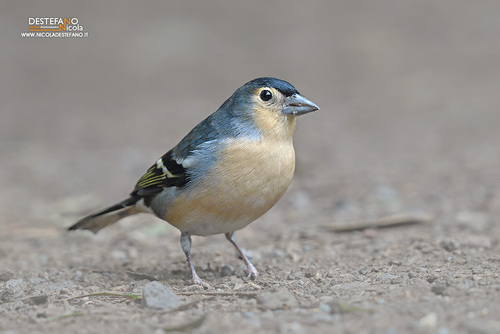
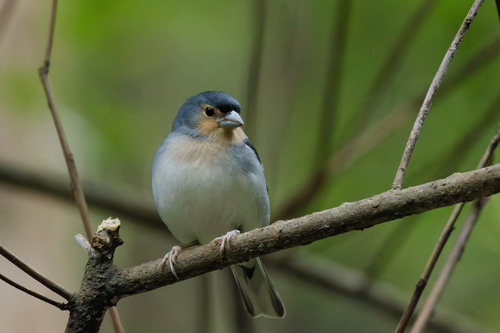
Males are strikingly beautiful, boasting a deep slate-blue crown and mantle that contrasts beautifully with a warm, buff-orange breast and throat. Females and juveniles display more subdued, cryptic coloration, with olive-brown upperparts and pale greyish-buff underparts, perfect for camouflaging in the dappled forest light. Both sexes share characteristic double white wing bars and white outer tail feathers, which are highly visible in flight. They possess a robust, conical grey bill ideal for cracking seeds, and measure roughly 14 to 16 cm in length with a compact, sturdy build.
Category
BirdsRarity
Common
Danger
1/5 · Very low
Snaps
Be the first to snap!
Each island population has its own 'accent'; a Tenerife chaffinch sings a noticeably different tune than a chaffinch from El Hierro.
The Canary Islands Chaffinch was historically grouped with the European Common Chaffinch but was split into its own distinct species due to significant genetic and vocal differences.
They are remarkably bold around humans in recreational areas, often hopping close to picnic tables to scavenge crumbs.
Populations across different Canary Islands have developed distinct vocal dialects, allowing individuals to recognize neighbors from their specific home island.
Equipped with strong, gripping claws and a versatile bill, they can hang upside down from twigs to extract insects and seeds from tight spaces.
They thrive across dramatic elevation gradients, seamlessly transitioning from sea-level laurel forests to pine zones nearly 2,000 meters high.
Feeds on a diverse mix of seeds, small fruits, and invertebrates, varying their intake based on seasonal availability.
Age differences: Chicks are fed an insect-rich diet for rapid growth, while adults transition to a more seed-oriented diet outside of the breeding season.
Pinus canariensis
Provides critical nesting habitat and seeds as a key food source.

Accipiter nisus
A primary avian predator that hunts adult chaffinches in the forest canopy.
Serinus canaria
Competes for seeds and nesting sites in overlapping woodland margins.
No trait badges are assigned for this object yet.
No aliases listed yet.
Collections for this object will appear here as more themes are added.
Danger
1/5 · Very low
No special safety notes yet.
Compare the silhouette, bill shape, tail length, wing bars and markings around the eyes. The same small brown bird at your feeder can look quite different in breeding plumage, winter plumage or its first year. Bird Identifier: upload a photo and compare the visible details.
14+ cm
24+ cm
0.02+ kg
Feeds on a diverse mix of seeds, small fruits, and invertebrates, varying their intake based on seasonal availability.
Found primarily in humid laurel forests and native Canary Island pine woodlands, occasionally venturing into adjacent gardens and agricultural areas.
Foraging
Zoom in to split clusters and explore where this object has been snapped.
Recent snaps will appear here as new observations are added.
Take the discovery with you
Snap it with Snappit to identify it, learn what makes it special, and add the discovery to your collection.