
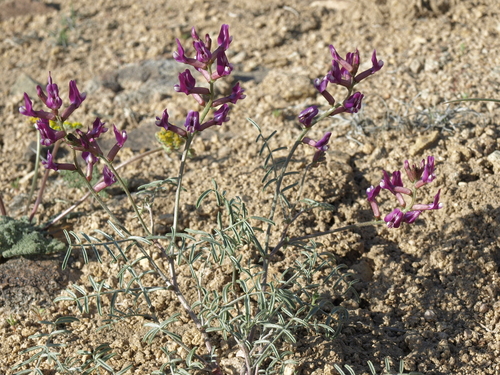


Case'S Milkvetch
astragalus casei
Case's Milkvetch (Astragalus casei) is a distinctive perennial herb belonging to the expansive pea family (Fabaceae), known for its resilience in arid and semi-arid environments of the western United States. This unassuming yet vital plant plays a crucial ecological role, often found clinging to rocky slopes and sandy flats where other vegetation struggles. It is characterized by its sprawling growth habit and delicate, pea-like flowers, which bring subtle beauty to harsh landscapes. Like many of its legume relatives, Astragalus casei is capable of nitrogen fixation, enriching the soil and supporting a complex web of life in its native habitats. Its hardy nature and unique adaptations make it a fascinating subject for botanists and a significant component of the local flora.
Habitat: Case's Milkvetch thrives in dry, open habitats, including sagebrush scrub, pinyon-juniper woodlands, and rocky slopes with sandy or gravelly, often volcanic, soils at elevations ranging from 1,200 to 2,800 meters.
This perennial plant typically forms low, matted growths, often appearing somewhat sprawling or cushion-like. Its leaves are pinnately compound, meaning they consist of multiple small leaflets arranged along a central stem, often with a silvery-green or gray-green hue due to fine hairs. The flowers, emerging from short stalks, are typical pea-shaped blossoms, usually purplish, pinkish, or sometimes cream to whitish, arranged in short, dense clusters. After flowering, it produces distinctive, often inflated or leathery, pea-like pods (legumes) that contain its seeds, which are a key identifier for the genus. The plant generally reaches a height of 10-30 cm.
Category
PlantsRarity
Common
Danger
1/5 · Very low
Snaps
Be the first to snap!
Case's Milkvetch is an important food source and habitat component for various native insects and small mammals in its arid ecosystem.
Many milkvetch species are known for producing a potent neurotoxin called swainsonine, which can be harmful to grazing livestock, though not all species are toxic.
The Fabaceae family, to which Case's Milkvetch belongs, is the third-largest family of flowering plants, with over 19,000 species worldwide.
The genus name Astragalus is derived from the Greek word for ankle bone, possibly referring to the shape of the seeds or pods of some species.
The plant forms a symbiotic relationship with specific soil bacteria in its root nodules, allowing it to convert atmospheric nitrogen into a usable form, enriching nutrient-poor soils.
Adaptations such as a deep taproot system and potentially hairy leaves help reduce water loss, enabling it to survive prolonged dry periods in arid environments.
It is specifically adapted to grow in challenging substrates like volcanic ash, gravelly flats, and sandy soils, where competition from other plants is limited.
Case's Milkvetch, as an autotrophic plant, produces its own food through photosynthesis, converting sunlight, water, and carbon dioxide into sugars. It also absorbs essential mineral nutrients from the soil via its root system.
Bombus occidentalis
Pollinates flowers

Odocoileus hemionus
Herbivory on foliage and seeds
Rhizobium leguminosarum
Nitrogen-fixing symbiosis

Cupido amyntula
Larval host plant
No trait badges are assigned for this object yet.
No aliases listed yet.
Collections for this object will appear here as more themes are added.
Danger
1/5 · Very low
No special safety notes yet.
Start with the whole plant, then compare leaf arrangement, leaf edges, stems and any flowers or fruit. Opposite leaves grow in pairs; alternate leaves come one at a time along the stem. These details tell you far more together than a single green leaf does. Plant Identifier: upload a photo and compare the visible details.
10-30 cm
0.01-0.1 kg
3-10 years
Case's Milkvetch, as an autotrophic plant, produces its own food through photosynthesis, converting sunlight, water, and carbon dioxide into sugars. It also absorbs essential mineral nutrients from the soil via its root system.
Case's Milkvetch thrives in dry, open habitats, including sagebrush scrub, pinyon-juniper woodlands, and rocky slopes with sandy or gravelly, often volcanic, soils at elevations ranging from 1,200 to 2,800 meters.
Nutrient Absorption
50-500
Zoom in to split clusters and explore where this object has been snapped.
Recent snaps will appear here as new observations are added.
Take the discovery with you
Snap it with Snappit to identify it, learn what makes it special, and add the discovery to your collection.


















