




catchweed bedstraw
Galium aparine
Catchweed bedstraw is a green plant that loves to climb and spread across the ground. It has tiny, star-shaped flowers and can stick to your clothes when you walk by!
Habitat: Grasslands
The catchweed bedstraw has weak, sprawling stems that are covered in tiny, backward-pointing hooks, allowing it to cling. Its narrow, lance-shaped leaves grow in whorls around the stem. It produces very small, star-like white flowers in clusters.
Category
PlantsRarity
Common
Danger
1/5 · Very low
Snaps
19
Farmers used to strain milk through tangled bedstraw stems before refrigeration!
Its tiny seeds are so tough, they can survive being eaten by birds!
People once used bundles of its stems to make a comfy 'bed' or mattress!
Young bedstraw leaves can be cooked and taste a bit like spinach!
Catchweed bedstraw has tiny hooked bristles on its stems, leaves, and seeds that help it cling to fur or clothing for easy travel and dispersal.
Its weak stems use the support of taller plants and structures to climb upwards, reaching sunlight without needing a strong stalk.

Homo sapiens
Young shoots can be eaten as a leafy green
Apis mellifera
Bees visit its small white flowers for nectar
Urtica dioica
Often climbs on taller plants like nettles for support
Climbing or vine plants are characterized by a growth habit that allows them to ascend upwards by twining, tendrils, or adhesive roots.
Flowering plants are any plants that produce flowers as part of their reproductive cycle.
Edible plants are those parts of a plant that are considered safe for human consumption.
Grassland habitats are terrestrial biomes dominated by grasses and herbaceous plants, supporting a variety of grazing animals.

Describes plants that are particularly attractive and beneficial to a wide range of pollinating organisms.

Rapid growing plants exhibit accelerated growth rates, quickly increasing in size and biomass within a short period.

Describes a relationship between two different species where they live in close association, often benefiting one or both.
No aliases listed yet.
Danger
1/5 · Very low
It's safe to touch, but be careful not to pull it out of the ground.
The easiest way to identify catchweed bedstraw is to use the Snappit nature identifier app.
30-200 cm
50-300 cm
0.1-0.2 cm
Spring-summer
Yes
None
Annual
Zoom in to split clusters and explore where this object has been snapped.
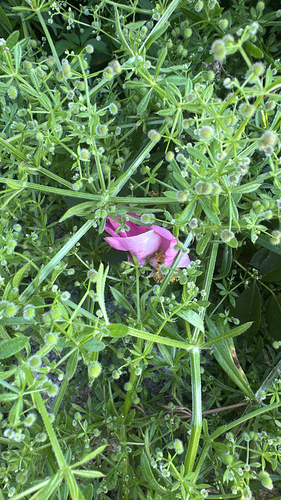
Jun 5, 2026
Charlton-King-Vandam Historic DistrictPhoto attribution
no rights reserved
License: CC0 1.0 ↗
Image may be shown cropped inside the card frame.
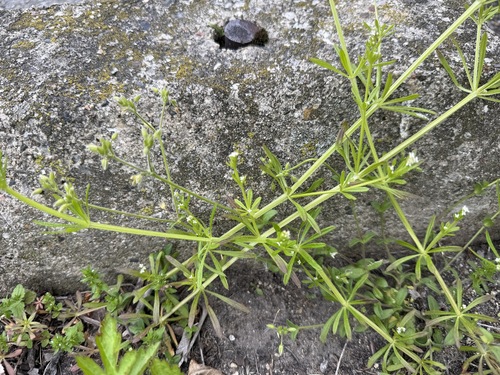
May 12, 2026
Richard Bong State Recreation AreaPhoto attribution
(c) Brandon Corder, some rights reserved (CC BY)
License: CC BY 4.0 ↗
Image may be shown cropped inside the card frame.

Georgia, US
You might spot Common Vetch, Tiny Bluet, and Carolina Crane's-Bill.
View guide →

Pennsylvania, US
You might spot American Robin, Red-Winged Blackbird, and Lesser Celandine.
View guide →

Ohio, US
You might spot Large White Trillium, Fire Pink, and Christmas Fern.
View guide →

Indiana, US
You might spot Common Reed, Rosepink, and Bearberry.
View guide →

Wisconsin, US
You might spot Common Eastern Bumble Bee, Red-Belted Bumble Bee, and Duck.
View guide →

Wisconsin, US
You might spot Eastern Forktail and Brown-Belted Bumble Bee.
View guide →
Take the discovery with you
Snap it with Snappit to identify it, learn what makes it special, and add the discovery to your collection.








.jpg&width=800)



_001.jpg&width=800)



