Cedar-Apple Rust
gymnosporangium juniperi-virginianae
Cedar-Apple Rust is a fascinating fungus that affects cedar and apple trees. It has a unique life cycle that involves both trees, making it a special part of nature's story.
Habitat: Cedar-Apple Rust thrives in areas with cedar and apple trees, often found in forests and gardens.
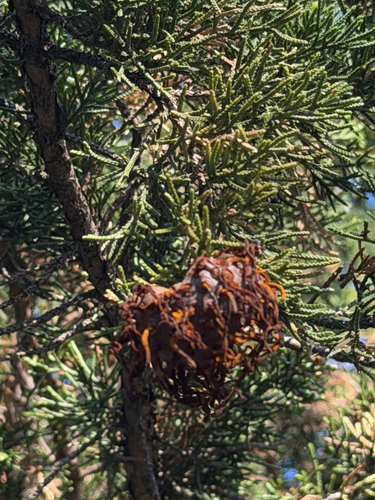
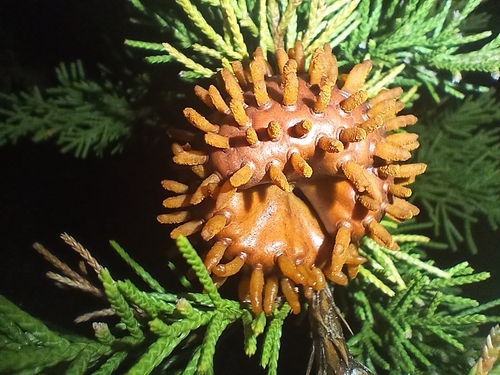
The Cedar-Apple Rust has striking bright orange, jelly-like galls that emerge from juniper branches. These galls sprout gelatinous "spore horns" during wet spring weather, making them look like alien sea creatures. It also creates yellow-orange spots on apple leaves.
Category
FungiRarity
Common
Danger
0/5 · No known danger
Snaps
12
The strange growths it causes on apple leaves are called "rust spots" and can make the fruit bumpy!
This fungus needs two completely different trees, a cedar and an apple, to finish its life!
Tiny, sticky spores from this fungus can travel for miles on the wind to find a new home.
When it rains, its galls on cedar trees amazingly transform into giant, gelatinous orange blobs!
Cedar-Apple Rust can jump between two different types of host plants, junipers and apple trees, because it needs both to complete its life cycle.
Cedar-Apple Rust has amazing orange, jelly-like "horns" that help it launch spores into the air when it's wet.
Cedar-Apple Rust can create bright yellow-orange spots on apple leaves, helping it absorb nutrients from the plant.
Juniperus virginiana
Forms galls on its branches.
Malus domestica
Causes rust spots on leaves and fruit.
Crataegus phaenopyrum
Can also infect hawthorn leaves and berries.
Colorful describes organisms or objects displaying a wide range of bright and distinct colors.
This trait characterizes organisms whose diet consists entirely or primarily of plant material.
Describes organisms that break down dead organic material, recycling nutrients back into the ecosystem.
Forest habitats are terrestrial environments dominated by dense tree cover, supporting a high diversity of plant and animal life.

Diurnal animals are primarily active during daylight hours, typically resting or sleeping at night.
Danger
0/5 · No known danger
No special safety notes yet.
The easiest way to identify Cedar-Apple Rust is to use the Snappit nature identifier app.
inedible
Cedar-Apple Rust thrives in areas with cedar and apple trees, often found in forests and gardens.
other
Spring
Orange-brown
Zoom in to split clusters and explore where this object has been snapped.
May 16, 2026
Bean Hill Historic DistrictPhoto attribution
(c) Sawyer Baran, some rights reserved (CC BY)
License: CC BY 4.0 ↗
Image may be shown cropped inside the card frame.
Apr 15, 2026
Coleman Station Historic DistrictPhoto attribution
no rights reserved
License: CC0 1.0 ↗
Image may be shown cropped inside the card frame.

Connecticut, US
You might spot Striped Wintergreen and Common Eastern Bumble Bee.
View guide →

Connecticut, US
You might spot Striped Wintergreen and Common Eastern Bumble Bee.
View guide →

Massachusetts, US
You might spot Eastern White Pine, Multiflora Rose, and Asian Bittersweet.
View guide →

West Virginia, US
You might spot Asian Lady Beetle, Eastern Box Turtle, and American Robin.
View guide →

Massachusetts, US
You might spot Red-Winged Blackbird and Great Blue Heron.
View guide →

New York, US
You might spot Eastern Newt, Turkey-Tail, and Trembling Crust.
View guide →
Take the discovery with you
Snap it with Snappit to identify it, learn what makes it special, and add the discovery to your collection.