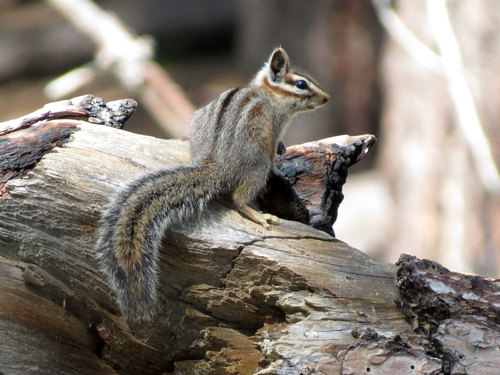


Cliff Chipmunk
neotamias dorsalis
The Cliff Chipmunk (Neotamias dorsalis) is a charismatic and highly agile rodent native to the mountainous regions of the southwestern United States and western Mexico. Unlike many of its cousins who prefer the cover of dense forest floors, this daring little acrobat is right at home navigating sheer vertical canyon walls and rocky talus slopes. They are frequently spotted darting across sandstone ledges, using their sharp claws and long, expressive tails to maintain balance in precarious situations. Their lively nature and bold foraging habits make them a delightful sight for hikers in rocky terrain.
Habitat: Typically found in rocky cliffs, canyons, talus slopes, and adjacent pinyon-juniper woodlands of the American Southwest.
This medium-sized chipmunk is characterized by its primarily gray coat, which provides excellent camouflage against rocky backgrounds. While it features the classic dark and light facial stripes of a chipmunk, the stripes along its sides are noticeably faint and blurry, leaving the dark stripe running down its spine as its most prominent marking. It features a pale cream-colored underbelly, large dark eyes, and a remarkably bushy, gray-and-black tail that it actively flicks when alarmed or communicating.
Category
MammalsRarity
Common
Danger
1/5 · Very low
Snaps
Be the first to snap!
Their faint side stripes are an evolutionary adaptation for camouflage, mimicking the shifting shadows of rocky cliffs rather than forest foliage.
To maintain balance during dramatic jumps between cliffs, they use their bushy tail as a dynamic rudder in mid-air.
Unlike many other chipmunks that hibernate deeply, the Cliff Chipmunk does not hibernate fully and may wake up to forage on warm, sunny winter days.
Possesses specialized claws and flexible ankles that allow it to scale vertical rock faces and jump between canyon crevices with extreme ease.
Features highly expandable cheek pouches used to hoard and transport seeds from open feeding areas back to the safety of its rocky den.
Employs a complex communication system consisting of high-pitched chirps and whistles to alert nearby family members of approaching predators.
An opportunistic feeder that primarily consumes seeds, nuts, and berries, but will readily supplement its diet with insects and small bird eggs.
Pinus edulis
Feeds heavily on seeds and assists in seed dispersal.

Accipiter cooperii
Preys on the chipmunk as a primary food source.

Otospermophilus variegatus
Competes for foraging resources and rocky nesting crevices.
No trait badges are assigned for this object yet.
No aliases listed yet.
Collections for this object will appear here as more themes are added.
Danger
1/5 · Very low
No special safety notes yet.
Compare ears, muzzle, tail, feet and coat markings. Size is hard to judge without something nearby for scale, and young mammals may not have adult coloring yet. Mammal Identifier: upload a photo and compare the visible details.
20+ cm
0.05+ kg
2+ years
15 km/h
An opportunistic feeder that primarily consumes seeds, nuts, and berries, but will readily supplement its diet with insects and small bird eggs.
Typically found in rocky cliffs, canyons, talus slopes, and adjacent pinyon-juniper woodlands of the American Southwest.
Foraging
Zoom in to split clusters and explore where this object has been snapped.
Recent snaps will appear here as new observations are added.
Take the discovery with you
Snap it with Snappit to identify it, learn what makes it special, and add the discovery to your collection.