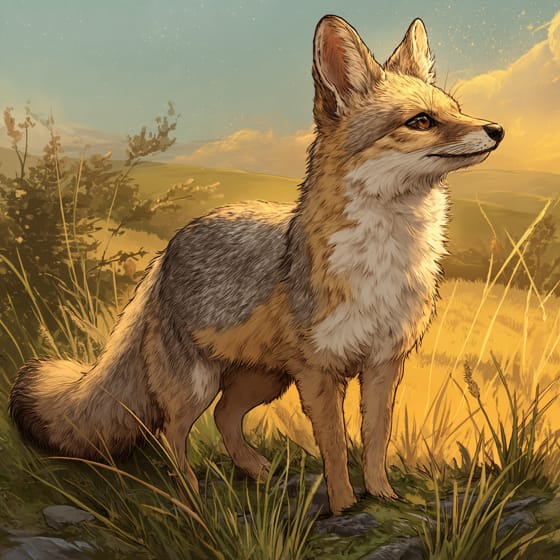





Corsac Fox
Vulpes corsac
The Corsac Fox is a small, desert-dwelling fox with a beautiful sandy coat. It's known for its excellent digging skills and sharp sense of hearing, helping it find food and avoid danger in the vast desert landscape.
Habitat: Desert
The Corsac Fox has soft, pale yellowish-grey to reddish-grey fur, often with a white chin and throat. Its belly is yellowish-white, and its bushy tail is tipped in dark brown. It has noticeably large, rounded ears relative to its head size.
Category
MammalsRarity
Common
Danger
2/5 · Low
Snaps
Be the first to snap!
Corsac foxes have excellent eyesight and hearing, helping them hunt at night or during twilight.
Corsac foxes often 'play dead' if caught by a predator, surprising their attacker for a chance to escape!
They rarely dig their own homes, preferring to live in abandoned burrows of marmots or badgers.
Unlike most foxes, they are more social, sometimes sharing dens and even hunting in small groups.
Corsac Foxes have huge, round ears that help them pinpoint tiny prey movements, even underground or in thick grass.
Corsac Foxes can quickly dig burrows with strong claws to escape danger, find shelter, or create new homes.
Corsac Foxes have thick fur that provides excellent insulation, keeping them warm in freezing winters and cool in hot summers.
These small foxes munch on rodents, insects, birds, and sometimes even a little bit of plants!
Rhombomys opimus
a primary food source in its desert habitat.
Ochotona daurica
a common small mammal prey in its range.
Canis lupus
a larger predator that preys on Corsac Foxes.
Marmota bobak
Corsac Foxes use their abandoned burrows for shelter.
Wildlife encompasses all undomesticated animal and plant life existing in their natural habitats.
Furry describes animals possessing a dense covering of soft hair or fur.
Social animals live in organized groups, cooperating for survival benefits such as foraging, defense, and raising offspring.
Burrowing animals dig tunnels and chambers in the ground, using these subterranean structures for shelter, hunting, or breeding.

Desert habitats are arid regions characterized by extremely low precipitation and often extreme temperatures, supporting specialized flora and fauna.

This habitat trait describes species found in steppes, which are dry, treeless grasslands characterized by extreme seasonal temperature variations and low precipitation.

This trait identifies organisms whose diet consists entirely or primarily of animal tissue.

Nocturnal animals are primarily active during the nighttime hours, typically resting or sleeping during the day.
Danger
2/5 · Low
Admire these foxes from a distance and never try to touch or feed them.
The easiest way to identify Corsac Fox is to use the Snappit nature identifier app.
45-60 cm
1.6-3.2 kg
3-6 years
60 km/h
These small foxes munch on rodents, insects, birds, and sometimes even a little bit of plants!
Desert
Pursuit
Zoom in to split clusters and explore where this object has been snapped.
Recent snaps will appear here as new observations are added.
Take the discovery with you
Snap it with Snappit to identify it, learn what makes it special, and add the discovery to your collection.




.jpg&width=800)



.JPG&width=800)


.jpg&width=800)
