

Descurainia Bourgaeana
descurainia bourgaeana
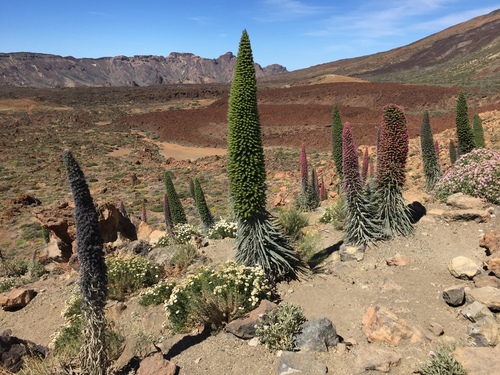
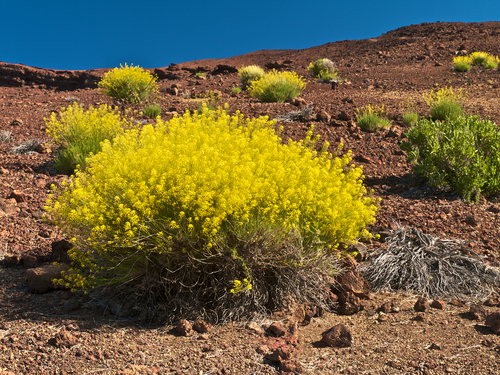
Descurainia bourgaeana, locally known as "hierba pajonera," is a remarkable high-altitude shrub endemic to the Canary Islands, primarily thriving in the subalpine volcanic plains of Mount Teide in Tenerife and high elevations in La Palma. This resilient plant forms dense, dome-shaped cushions that endure extreme environmental conditions, including freezing winter temperatures, scorching summer heat, and dry, nutrient-poor volcanic soils. In late spring, it undergoes a spectacular transformation, erupting into a vibrant mass of bright yellow blossoms that blanket the caldera floors and rocky slopes. It plays a critical ecological role as a pioneer species, helping to stabilize loose volcanic ash and providing a vital nectar source for alpine pollinators.
Habitat: Found in high-altitude subalpine scrublands on dry volcanic pumice, lava flows, and rocky slopes, primarily at elevations between 2,000 and 2,500 meters.
This species grows as a highly branched, dense, hemispherical shrub reaching heights of 40 to 100 centimeters. It features grayish-green, deeply divided, lobed leaves covered in fine, star-shaped hairs that give the foliage a velvety appearance and help reflect excess radiation. During its blooming season from May to June, the plant is completely covered with dense, erect clusters of small, four-petaled yellow flowers. After flowering, it produces narrow, upright seed pods (siliques) that eventually dry out, leaving a straw-like skeleton that persists through the winter.
Category
PlantsRarity
Common
Danger
1/5 · Very low
Snaps
Be the first to snap!
It is a resilient survivor of thermal shock, enduring temperatures below freezing at night and over 35 degrees Celsius during summer days.
Its common name 'hierba pajonera' (straw grass) refers to the dry, straw-like skeleton the plant turns into during the dry summer months.
The plant's vibrant yellow dome blooms are so dense and numerous that they can be easily seen from satellite imagery of Teide National Park during peak spring.
The dense, rounded cushion shape protects the inner stems from high wind damage and helps create a buffered microclimate that retains moisture.
Possesses a highly efficient root system that can anchor in loose volcanic pumice and extract sparse moisture and nutrients from young volcanic soils.
The fine, dense hairs covering its leaves reduce water loss from transpiration and shield the plant tissues from intense ultraviolet light at high altitudes.
As a photosynthetic plant, it synthesizes its own organic compounds using sunlight, carbon dioxide, water, and minerals absorbed from the soil.
Gallotia galloti
The endemic lizard feeds on the flowers and fruits of the plant, assisting in seed dispersal.
Anthophora alluaudi
The endemic solitary bee visits the flowers for nectar, acting as a primary pollinator.

Oryctolagus cuniculus
Introduced European rabbits browse on the tender spring shoots and can cause localized damage.
No trait badges are assigned for this object yet.
No aliases listed yet.
Collections for this object will appear here as more themes are added.
Danger
1/5 · Very low
No special safety notes yet.
Start with the whole plant, then compare leaf arrangement, leaf edges, stems and any flowers or fruit. Opposite leaves grow in pairs; alternate leaves come one at a time along the stem. These details tell you far more together than a single green leaf does. Plant Identifier: upload a photo and compare the visible details.
40-100 cm
5-15 years
As a photosynthetic plant, it synthesizes its own organic compounds using sunlight, carbon dioxide, water, and minerals absorbed from the soil.
Found in high-altitude subalpine scrublands on dry volcanic pumice, lava flows, and rocky slopes, primarily at elevations between 2,000 and 2,500 meters.
Photosynthesis
Zoom in to split clusters and explore where this object has been snapped.
Recent snaps will appear here as new observations are added.
Take the discovery with you
Snap it with Snappit to identify it, learn what makes it special, and add the discovery to your collection.