
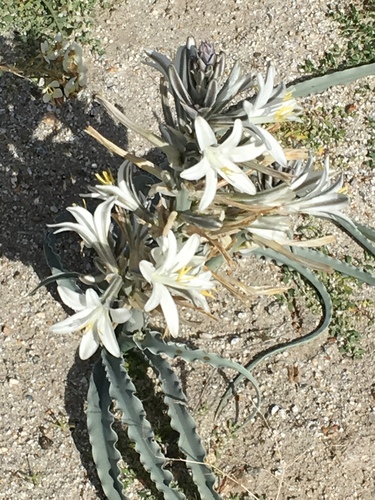


Desert Lily
hesperocallis undulata
The Desert Lily (Hesperocallis undulata) is a stunning perennial wildflower that breathes life into the arid expanses of the Mojave and Sonoran deserts. Emerging from a deep-seated bulb, this resilient plant stands as a testament to survival in extreme environments. After winter rains, it produces striking, fragrant white blossoms that stand out brilliantly against the harsh, sandy desert backdrop. This species has captured the imagination of desert travelers for generations. It is famously nicknamed the "ajo lily" due to the garlic-like flavor of its edible bulb, which was historically used by indigenous populations as a valuable food source. Its brief, dramatic bloom represents one of the most spectacular spring displays in the American Southwest.
Habitat: Found in sandy plains, dunes, and flat desert washes below 800 meters in elevation.
The Desert Lily is easily recognized by its tall, sturdy flower stalk, which ranges from 30 to 180 cm in height, bearing a terminal cluster of several large, funnel-shaped white flowers. Each flower features six tepals, white on the inside and marked with a distinctive silvery-green or purplish band on the reverse side. Its leaves are long, narrow, and strap-like, with highly wavy or crinkled margins that grow in a basal rosette close to the sandy ground.
Category
PlantsRarity
Common
Danger
1/5 · Very low
Snaps
Be the first to snap!
Despite its common name and appearance, recent genetic studies place the Desert Lily closer to agaves and hostas than to true lilies.
Indigenous peoples of the Southwest, such as the Cahuilla, gathered the bulbs as a valuable food source, eating them raw, boiled, or roasted.
The Spanish name for the plant, 'Ajo Lily', translates to 'Garlic Lily', referencing the strong garlic-like scent and flavor of the bulb.
The bulbs can remain dormant deep underground for several consecutive dry years, waiting for sufficient winter rainfall to trigger growth.
A thick, waxy cuticle covers the wavy leaves to minimize water loss from transpiration in dry, hot desert winds.
The bulb grows deep beneath the surface, protected from extreme surface temperatures and foraging animals.
As a photosynthetic plant, the Desert Lily synthesizes its own food using sunlight, water, carbon dioxide, and essential soil minerals.
Manduca sexta
The flowers are pollinated by sphinx moths, which are attracted to their strong fragrance during dusk and nighttime.

Ammospermophilus leucurus
Desert rodents occasionally dig up and feed on the nutrient-rich bulbs during times of drought.
No trait badges are assigned for this object yet.
No aliases listed yet.
Collections for this object will appear here as more themes are added.
Danger
1/5 · Very low
No special safety notes yet.
Start with the whole plant, then compare leaf arrangement, leaf edges, stems and any flowers or fruit. Opposite leaves grow in pairs; alternate leaves come one at a time along the stem. These details tell you far more together than a single green leaf does. Plant Identifier: upload a photo and compare the visible details.
30-180 cm
0.1-0.8 kg
5-20 years
As a photosynthetic plant, the Desert Lily synthesizes its own food using sunlight, water, carbon dioxide, and essential soil minerals.
Found in sandy plains, dunes, and flat desert washes below 800 meters in elevation.
Zoom in to split clusters and explore where this object has been snapped.
Recent snaps will appear here as new observations are added.
Take the discovery with you
Snap it with Snappit to identify it, learn what makes it special, and add the discovery to your collection.


















