
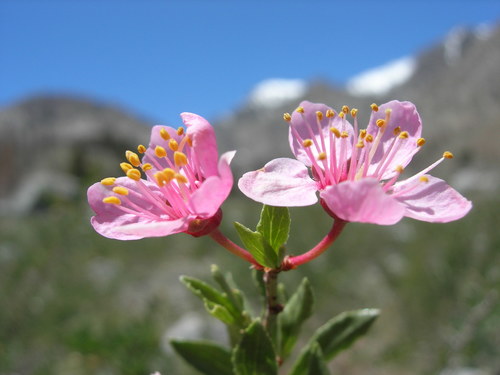


Desert Peach
prunus andersonii
The Desert Peach (Prunus andersonii) is a hardy and fascinating shrub native to the arid and semi-arid regions of the western United States. A member of the rose family, it stands out for its remarkable resilience, thriving in harsh, rocky environments where few other plants can survive. This species is particularly notable for its delicate pink blossoms that emerge in early spring, bringing a splash of color to the often-drab desert landscape, followed by small, fuzzy fruits that resemble miniature peaches. Beyond its aesthetic appeal, the Desert Peach plays a crucial ecological role, providing vital food and habitat for various desert wildlife, making it a cornerstone of its unique ecosystem. Its adaptation to extreme conditions, including drought and poor soils, underscores its significance as a botanical survivor.
Habitat: This shrub is typically found on dry, rocky slopes, canyon bottoms, and sagebrush scrub communities in arid and semi-arid environments.
Desert Peach is a deciduous, thorny shrub typically growing 0.5 to 2 meters tall with a spreading, somewhat tangled form. Its branches are stiff and often armed with sharp spines. The leaves are small, oblong to elliptical, and smooth-edged, often appearing reddish or yellowish-green. In early spring, it produces numerous small, five-petaled flowers, ranging from pale pink to rose-purple, usually appearing before the leaves fully emerge. The most distinctive feature is its fruit: small, round to ovate drupes, 1-2 cm in diameter, covered in dense, velvety fuzz, ripening from green to yellow or orange-red in summer.
Category
PlantsRarity
Common
Danger
1/5 · Very low
Snaps
Be the first to snap!
Despite its common name, the 'peach' fruits of Prunus andersonii are quite tart and fuzzy, not as sweet or juicy as cultivated peaches, but edible and a vital food source for wildlife.
It is one of the few Prunus species naturally occurring in arid, desert environments, showcasing remarkable adaptation within a genus typically found in more mesic (moist) climates.
Its early spring bloom provides a critical nectar source for native pollinators, often being one of the first flowering plants in its harsh desert ecosystem.
Native Americans, such as the Paiute and Shoshone, traditionally harvested and ate the fruits, sometimes drying them for later use, and extracted a reddish dye from the seeds.
Its deep root system and small, thick leaves allow it to minimize water loss and access scarce underground water, enabling survival in prolonged droughts common to its desert habitat.
The rigid, spiny branches provide an effective physical deterrent against browsing herbivores, protecting its foliage and developing fruits from predation in nutrient-scarce environments.
Desert Peach is often one of the first woody plants to colonize disturbed or eroded desert soils, demonstrating its ability to establish and thrive in challenging, nutrient-poor, and unstable ground conditions.
As a photosynthetic plant, Desert Peach produces its own energy by converting sunlight, carbon dioxide, and water into sugars, utilizing nutrients absorbed from the soil to support growth.

Canis latrans
Consumes fruits, aiding in seed dispersal through scat.

Odocoileus hemionus
Browses on foliage and twigs, especially during drought periods.
various species (e.g., Andrena spp.)
Pollinates flowers, facilitating reproduction.
Thomomys spp.
May consume roots and damage plant, especially younger specimens.
No trait badges are assigned for this object yet.
No aliases listed yet.
Collections for this object will appear here as more themes are added.
Danger
1/5 · Very low
No special safety notes yet.
Start with the whole plant, then compare leaf arrangement, leaf edges, stems and any flowers or fruit. Opposite leaves grow in pairs; alternate leaves come one at a time along the stem. These details tell you far more together than a single green leaf does. Plant Identifier: upload a photo and compare the visible details.
50-200 cm
1-15 kg
10-50 years
As a photosynthetic plant, Desert Peach produces its own energy by converting sunlight, carbon dioxide, and water into sugars, utilizing nutrients absorbed from the soil to support growth.
This shrub is typically found on dry, rocky slopes, canyon bottoms, and sagebrush scrub communities in arid and semi-arid environments.
Photosynthesis
Zoom in to split clusters and explore where this object has been snapped.
Recent snaps will appear here as new observations are added.
Take the discovery with you
Snap it with Snappit to identify it, learn what makes it special, and add the discovery to your collection.


















