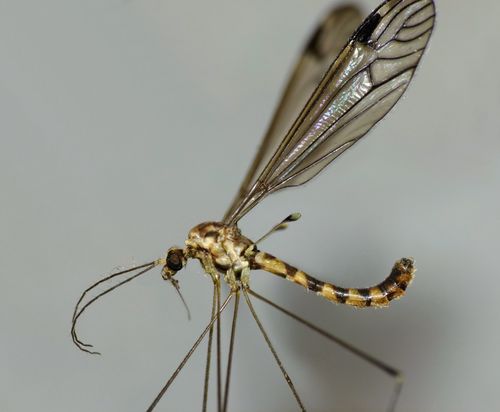


Dolichopeza
dolichopeza
Dolichopeza, a genus within the Tipulidae family, commonly known as crane flies, represents a fascinating group of insects often mistaken for giant mosquitoes. These delicate creatures play an important ecological role, particularly their larval forms, which are crucial decomposers in various terrestrial habitats. Adults are typically short-lived, focusing primarily on reproduction. Despite their somewhat intimidating size and appearance, Dolichopeza species are entirely harmless to humans, feeding on nectar or not at all as adults, and their larvae consuming decaying organic matter. Their presence is often an indicator of a healthy, moist ecosystem.
Habitat: Found in moist, shaded environments such as forest floors, wetlands, and riparian zones, often near decaying wood or leaf litter.
Dolichopeza crane flies are characterized by their extremely slender bodies, disproportionately long, fragile legs, and a pair of long, narrow, often translucent wings. Their coloration typically ranges from light brown to grayish, sometimes with darker markings on the thorax. The head is relatively small with prominent compound eyes and short antennae. They generally measure between 1 to 3 centimeters in body length, with a wingspan that can easily exceed their body length, giving them a very gangly appearance in flight or at rest.
Category
InsectsRarity
Common
Danger
1/5 · Very low
Snaps
Be the first to snap!
Adult crane flies have a very short lifespan, often just a few days to a couple of weeks, primarily focused on mating and egg-laying.
Despite their mosquito-like appearance and large size, adult crane flies (including Dolichopeza) do not bite humans or animals.
Dolichopeza larvae, sometimes called 'leatherjackets', are important decomposers that help enrich soil, making them beneficial to ecosystems.
The common name 'daddy long-legs' is often confusingly applied to crane flies, cellar spiders, and harvestmen, though they are vastly different creatures.
The larval stages of Dolichopeza are crucial detritivores, efficiently breaking down decaying plant matter, fungi, and other organic debris. This process recycles nutrients back into the ecosystem, making them vital to soil health.
Their extremely long and delicate legs are easily shed when grasped by a predator. This autotomy allows the crane fly to escape, sacrificing a limb to save its life, similar to some lizards losing their tails.
Adults of some Dolichopeza species possess the remarkable ability to walk or skate on the surface of water. This adaptation helps them navigate their damp habitats and sometimes escape aquatic predators.
Dolichopeza larvae are primarily detritivores, feeding on decaying organic matter found in moist soil and leaf litter. Adult crane flies typically feed on nectar or honeydew, if at all, and some species may not feed during their short adult lifespan.
Age differences: Larvae are detritivorous, while adults may consume nectar for energy or abstain from feeding entirely, focusing on reproduction.

Anax junius
Adults and larvae are a food source for various insectivores.
Quercus robur
Larvae break down organic matter in soil.

Araneus diadematus
Adults may be preyed upon by arachnids.

Anaxyrus americanus
Larvae are a food source for ground-dwelling predators.
No trait badges are assigned for this object yet.
No aliases listed yet.
Collections for this object will appear here as more themes are added.
Danger
1/5 · Very low
No special safety notes yet.
Look for six legs, antennae, three body sections and the shape of the wings. Beetles have hardened front wings; flies have just one working pair. Tiny insects may need a close view before their group is clear. Insect Identifier: upload a photo and compare the visible details.
1-3 cm
2-5 cm
0.0001-0.0005 kg
8 km/h
Dolichopeza larvae are primarily detritivores, feeding on decaying organic matter found in moist soil and leaf litter. Adult crane flies typically feed on nectar or honeydew, if at all, and some species may not feed during their short adult lifespan.
Found in moist, shaded environments such as forest floors, wetlands, and riparian zones, often near decaying wood or leaf litter.
Foraging
Zoom in to split clusters and explore where this object has been snapped.
Recent snaps will appear here as new observations are added.
Take the discovery with you
Snap it with Snappit to identify it, learn what makes it special, and add the discovery to your collection.