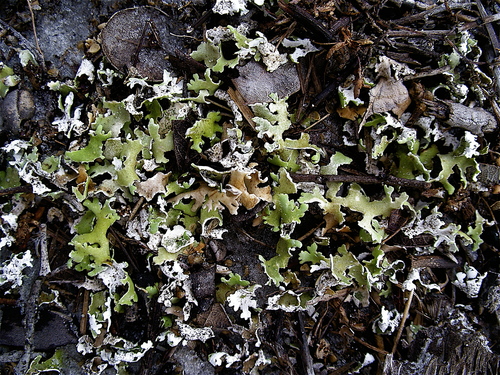
Dune Cup Lichen
cladonia prostrata
The Dune Cup Lichen looks like tiny green cups sprinkled across the sandy ground! It helps keep the environment healthy by breaking down rocks and adding nutrients to the soil.
Habitat: Coastal sandy areas and dunes.
The Dune Cup Lichen has a distinctive greyish-green to brownish-green appearance, often forming small, cup-shaped or branched structures. It typically grows low to the ground, creating a textured, crust-like or shrubby mat on sandy surfaces.
Category
FungiRarity
Common
Danger
0/5 · No known danger
Snaps
Be the first to snap!
Arctic reindeer eat lots of lichen to stay healthy during winter!
Lichens are like tiny weather stations, super sensitive to clean or dirty air.
Some lichens grow so slowly, they can be hundreds of years old!
They are nature's tiny pioneers, helping break down rocks to make new soil.
Dune Cup Lichen can completely dry out and go dormant, then reawaken when rain returns, allowing it to survive harsh droughts.
Dune Cup Lichen has no roots! It can absorb all its water and nutrients directly from the air and rain.
Dune Cup Lichen is a team of fungus and algae living together, where the fungus provides shelter and the algae makes food.
Trebouxia erici
provides food through photosynthesis

Arion ater
grazes on its surface
Isotoma viridis
lives within its tiny branches
Solitary animals live alone for most of their lives, only interacting with others for mating or parental care.
Colorful describes organisms or objects displaying a wide range of bright and distinct colors.
Describes organisms that break down dead organic material, recycling nutrients back into the ecosystem.
Coastal habitats are dynamic environments located along the interface between land and sea, influenced by tides, waves, and saltwater.

Diurnal animals are primarily active during daylight hours, typically resting or sleeping at night.
Danger
0/5 · No known danger
No special safety notes yet.
The easiest way to identify Dune Cup Lichen is to use the Snappit nature identifier app.
1-5 cm
5-20 cm
No
None
Perennial
Coastal sandy areas and dunes.
Zoom in to split clusters and explore where this object has been snapped.
Recent snaps will appear here as new observations are added.
Take the discovery with you
Snap it with Snappit to identify it, learn what makes it special, and add the discovery to your collection.