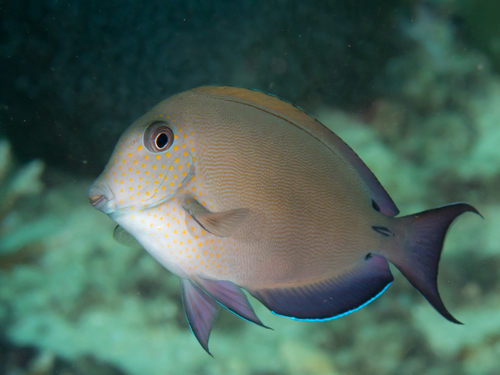


Dusky Surgeonfish
acanthurus nigrofuscus
The Dusky Surgeonfish, Acanthurus nigrofuscus, is a common and ecologically vital inhabitant of coral and rocky reefs across the Indo-Pacific. Known for its industrious grazing habits, this species plays a crucial role in maintaining the delicate balance of reef ecosystems by preventing the overgrowth of macroalgae, which could otherwise smother corals. They are often observed forming large, conspicuous schools, a behavior that offers protection against predators and facilitates efficient foraging across vast areas of the reef. Their active, diurnal lifestyle makes them a frequent sight for divers and snorkelers, embodying the vibrancy and intricate interactions of healthy marine environments.
Habitat: Found in shallow coastal waters, particularly in coral reefs, rocky reefs, lagoons, and areas with mixed rubble, sand, and seagrass beds.
The Dusky Surgeonfish typically displays an oval, laterally compressed body, reaching up to 25 cm in length. Its coloration ranges from brownish-purple to a deep dark brown, often with a subtle pale or whitish band visible around the gill opening and at the base of the pectoral fin. A key identification feature is the distinctive dark spot located at the posterior bases of both the dorsal and anal fins. Like all surgeonfish, it possesses a sharp, retractable scalpel-like spine on each side of its caudal peduncle, which is used for defense and can be a lighter or yellowish color.
Category
FishRarity
Common
Danger
1/5 · Very low
Snaps
1
Dusky Surgeonfish are often seen cleaning algae off of other fish, a behavior beneficial to both parties.
Juvenile Dusky Surgeonfish frequently associate with damselfishes, possibly for enhanced protection, before joining larger schools of their own kind.
Their 'scalpel' spine is not only sharp but also can contain mild toxins, making them formidable defenders despite their peaceful grazing nature.
They can rapidly change the intensity of their body coloration, often darkening when stressed or frightened, or lightening when relaxed.
These fish are highly efficient herbivores, constantly grazing on filamentous and fleshy algae. This sustained feeding prevents algal overgrowth, which is crucial for the health and survival of coral colonies.
Each Dusky Surgeonfish possesses a sharp, venomous spine on either side of its tail base, resembling a surgeon's scalpel. This retractable weapon is used for defense against predators and territorial disputes with other fish.
Dusky Surgeonfish often form large, coordinated schools, sometimes numbering in the hundreds or thousands. This schooling behavior provides safety in numbers, confusing predators, and allows for more efficient foraging over larger reef areas.
The Dusky Surgeonfish is a primary herbivore, diligently grazing on various types of microalgae and macroalgae. Their feeding habits are essential for coral reef ecosystems, as they prevent algal dominance and facilitate coral growth.
Age differences: Juveniles generally consume finer algae and microalgae, gradually broadening their diet to include a wider range of fleshy macroalgae as they mature.
Scleractinia
Main habitat provider and benefits from algae removal by surgeonfish.

Epinephelus spp.
Larger predatory fish that prey on surgeonfish, especially juveniles.
Scaridae
Another major herbivore on reefs, competing for algal resources.
No trait badges are assigned for this object yet.
No aliases listed yet.
Collections for this object will appear here as more themes are added.
Danger
1/5 · Very low
No special safety notes yet.
Look at body shape, where the fins sit and their outline, mouth position, stripes and spots. Young fish and breeding adults can wear different patterns, and aquarium color varieties can look nothing like wild fish. Fish Identifier: upload a photo and compare the visible details.
10-25 cm
0.05-0.3 kg
5-10 years
The Dusky Surgeonfish is a primary herbivore, diligently grazing on various types of microalgae and macroalgae. Their feeding habits are essential for coral reef ecosystems, as they prevent algal dominance and facilitate coral growth.
Found in shallow coastal waters, particularly in coral reefs, rocky reefs, lagoons, and areas with mixed rubble, sand, and seagrass beds.
Grazing
50000-500000
Zoom in to split clusters and explore where this object has been snapped.
Take the discovery with you
Snap it with Snappit to identify it, learn what makes it special, and add the discovery to your collection.