




Grouper
Epinephelus marginatus
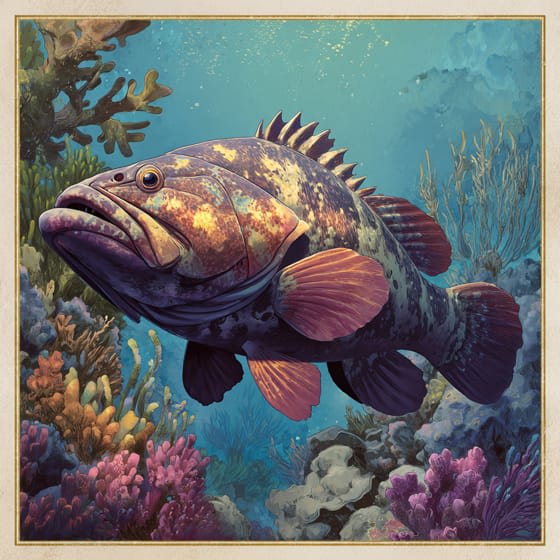
Grouper is a large fish that lives in the ocean. It has a big mouth and likes to hide in coral reefs. Grouper fish come in different colors like red, brown, and yellow.
Habitat: Coastal areas
The Grouper has a robust, oblong body often mottled with shades of brown, grey, or reddish-orange, helping it blend into rocky reefs. It possesses a very large mouth and thick lips, with small eyes set high on its head. Its camouflaged patterns make it visually distinct from fast-swimming open-ocean fish.
Category
FishRarity
Common
Danger
2/5 · Low
Snaps
Be the first to snap!
A massive Goliath Grouper can weigh more than two adult humans combined!
Groupers can suddenly open their giant mouths, creating a vacuum that sucks in prey instantly!
Some groupers practice 'cooperative hunting,' teaming up with moray eels to catch prey!
They are protogynous hermaphrodites, meaning many start as female and become male later in life!
Grouper can change its skin patterns and color to perfectly match its surroundings, helping them ambush prey unnoticed.
Grouper can rapidly open its large mouth, creating a powerful suction that pulls unsuspecting prey directly inside.
Grouper can vibrate its swim bladder to create deep, booming sounds, that helps them communicate with other groupers.
Grouper can change its sex from female to male later in life, that helps them adapt to social group needs.
Groupers are fierce hunters, eating mostly other fish, crabs, and octopuses.
Age differences: Younger groupers eat more crustaceans; larger adults focus on bigger fish.

Gymnothorax funebris
Cooperative hunting partners on reefs.
Dascyllus trimaculatus
Preys on smaller reef fish.
Octopus vulgaris
Preys on octopuses hiding in crevices.
Homo sapiens
Hunted for food and sport globally.
Social animals live in organized groups, cooperating for survival benefits such as foraging, defense, and raising offspring.
Camouflaged describes organisms that possess coloring or patterns that allow them to blend into their environment.
Colorful describes organisms or objects displaying a wide range of bright and distinct colors.
Piscivorous organisms are animals that primarily subsist on a diet of fish.

Describes a relationship between two different species where they live in close association, often benefiting one or both.

This trait describes organisms that manipulate external objects to achieve a specific goal.

An ambush predator hunts by patiently waiting and concealing itself, then launching a sudden attack when unsuspecting prey comes within range.

Coastal habitats are dynamic environments located along the interface between land and sea, influenced by tides, waves, and saltwater.

Describes a species whose presence and role have a disproportionately large effect on its environment.

Aquatic habitats encompass environments where organisms live predominantly in water, including oceans, rivers, lakes, and wetlands.

Marine habitats encompass all saltwater environments of the Earth's oceans, supporting an immense diversity of aquatic life.
Danger
2/5 · Low
Enjoy watching groupers from a safe distance and never try to touch them.
The easiest way to identify Grouper is to use the Snappit nature identifier app.
30-250 cm
1-400 kg
10-50 years
Groupers are fierce hunters, eating mostly other fish, crabs, and octopuses.
15 km/h
Coastal areas
Ambush
Zoom in to split clusters and explore where this object has been snapped.
Recent snaps will appear here as new observations are added.

Ohio, US
You might spot Sand Tiger Shark, Nurse Shark, and Cow.
View guide →
Oregon, US
You might spot Sea Otter, Harbor Seal, and Sea Lion.
View guide →

California, US
You might spot Sea Otter, Bull Kelp, and Box Jellyfish.
View guide →

California, US
You might spot Pacific Hairy Hermit Crab, Sea Urchin, and Sea Cucumber.
View guide →
Take the discovery with you
Snap it with Snappit to identify it, learn what makes it special, and add the discovery to your collection.