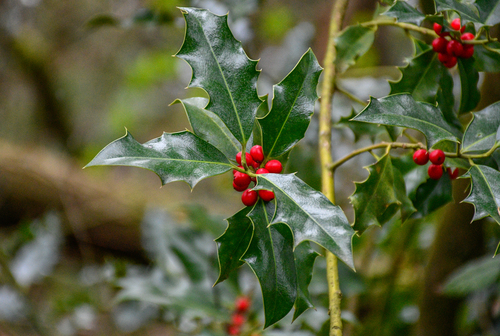


European Holly
ilex aquifolium
European Holly, instantly recognizable by its glossy, spiky leaves and vibrant crimson berries, is a quintessential symbol of winter resilience. Native to the understories of European forests, this hardy evergreen shrub or small tree has entrenched itself deeply in human culture and ecology alike. Often associated with festive winter traditions, the holly tree plays a far more critical role in its natural habitat than mere decoration. Its dense foliage provides year-round shelter for nesting birds and small mammals, acting as a vital refuge when deciduous trees lose their canopy. Because it is dioecious, meaning individual plants are either strictly male or strictly female, both are required to produce the iconic red berries. These berries, while toxic to humans and pets, are a crucial winter food source for birds like thrushes and blackbirds, making the European Holly a cornerstone species in its woodland ecosystems.
Habitat: Found in moist broadleaf woodlands, often growing as an understory shrub beneath oak and beech trees.
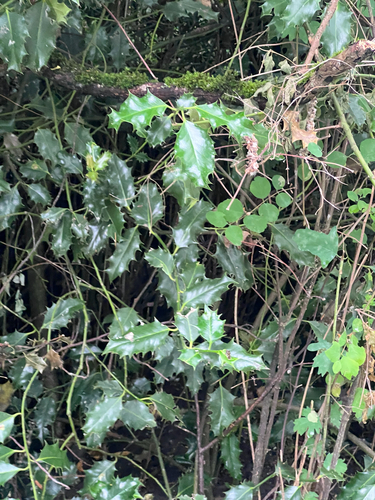
The European Holly is an evergreen shrub or small tree characterized by its dark green, highly glossy, and leathery leaves. The leaves are typically 5 to 12 centimeters long, often featuring heavily undulating margins with sharp, stiff spines, though leaves on older, higher branches may surprisingly grow smooth edges. Its bark is remarkably smooth and silver-grey. In late spring, it produces clusters of small, fragrant, four-petaled white flowers. In autumn and winter, the female plants yield bright red, spherical drupes (commonly called berries), each about 6 to 10 millimeters in diameter, creating a striking contrast against the dark foliage.
Category
PlantsRarity
Common
Danger
1/5 · Very low
Snaps
1
Ancient druids considered the holly tree sacred, believing its evergreen nature proved it had magical powers to stay alive through the harshness of winter.
Because European Holly is dioecious, you need both a male and a female plant growing close together for the female to produce its famous red berries.
The wood of the European Holly is extremely pale, heavy, and hard; historically, it was often dyed black to serve as a cheaper substitute for ebony on piano keys.
When holly branches grow high enough to escape the reach of browsing animals like deer, the plant actively stops producing spines on those upper leaves to save energy.
Lower leaves develop sharp, rigid spines to deter grazing herbivores, while upper branches out of reach often produce smooth, spineless leaves.
Its thick, waxy leaf cuticles and specialized cellular structure allow it to survive freezing temperatures and retain its photosynthetic foliage year-round.
The plant produces bright red berries containing compounds that are mildly toxic to mammals but perfectly suited for digestion by birds, ensuring safe seed dispersal.
As a photosynthetic plant, European Holly produces its own energy using sunlight, water, and carbon dioxide.
Turdus merula
Thrushes and blackbirds feed extensively on holly berries during winter, aiding in seed dispersal.
_male.jpg&width=800)
Celastrina argiolus
The Holly Blue butterfly relies heavily on the European Holly as a primary food source for its spring generation of caterpillars.
Phytomyza ilicis
The holly leaf miner fly lays its eggs in the leaves, where the larvae feed and create characteristic meandering trails.
No trait badges are assigned for this object yet.
No aliases listed yet.
Collections for this object will appear here as more themes are added.
Danger
1/5 · Very low
No special safety notes yet.
The easiest way to identify European Holly is to use the Snappit nature identifier app.
200-2500 cm
100-300 years
As a photosynthetic plant, European Holly produces its own energy using sunlight, water, and carbon dioxide.
Found in moist broadleaf woodlands, often growing as an understory shrub beneath oak and beech trees.
Photosynthesis
Zoom in to split clusters and explore where this object has been snapped.
Jun 21, 2025
FairhavenPhoto attribution
(c) Ryan McMinds, some rights reserved (CC BY)
License: CC BY 4.0 ↗
Image may be shown cropped inside the card frame.

Washington, US
You might spot Bigleaf Maple, Mule Deer, and Oregon Grape.
View guide →

Washington, US
You might spot Snowy Owl, Bee, and American Crow.
View guide →
British Columbia, CA
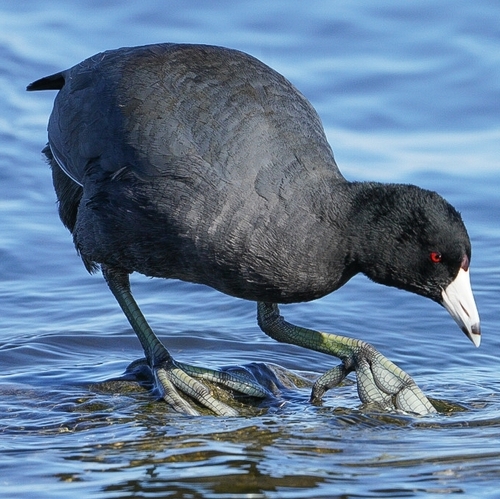
You might spot American Coot, Duck, and Canada Goose.
View guide →

Washington, US
You might spot Red Valerian, Ocean Spray, and Yellow Shore Crab.
View guide →

Washington, US
You might spot Western Sword Fern, Cross Orbweaver, and Western Redcedar.
View guide →

British Columbia, CA
You might spot Common Bracken, Vanilla Leaf, and Western Sword Fern.
View guide →
Take the discovery with you
Snap it with Snappit to identify it, learn what makes it special, and add the discovery to your collection.












.jpg&width=800)



_001.jpg&width=800)




