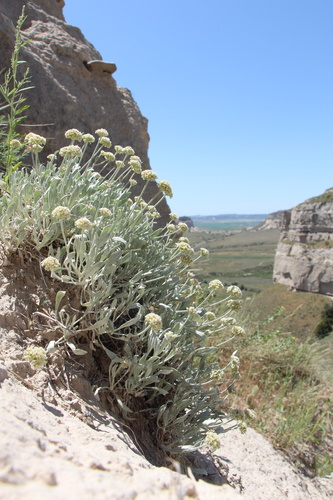


Few-Flower Buckwheat
eriogonum pauciflorum
Few-Flower Buckwheat is a resilient, low-growing perennial plant native to the dry badlands, clay slopes, and rocky ridges of western North America. Despite its humble name, this species plays a vital role in its harsh, arid ecosystems by stabilizing volatile soils and providing crucial nourishment for local pollinators. Forming dense, cushion-like mats, it thrives where few other plants can survive, enduring extreme winds and intense summer heat. Its delicate blossoms, ranging from creamy white to soft pink, provide a beautiful contrast against the stark, rugged landscapes it calls home. For hikers and nature enthusiasts exploring the Great Plains or the foothills of the Rockies, finding a patch of Few-Flower Buckwheat is a testament to the quiet strength and adaptability of native flora.
Habitat: Typically found in dry, barren environments such as clay hills, badlands, rocky ridges, and open plains of western North America.
This species forms compact, woody-based mats or tufts, standing only 5 to 20 centimeters tall. Its small, narrow leaves are linear to spatulate, often covered in a dense layer of white, woolly hairs that give them a silvery-green appearance. The flowers are arranged in small, dense, head-like clusters at the tips of leafless, upright stems. Each tiny, bell-shaped flower is white, cream, or pale pink, often with a darker rose-colored midrib on the petals, blooming from late spring through summer.
Category
PlantsRarity
Common
Danger
1/5 · Very low
Snaps
1
The dense, woolly hairs on its leaves not only conserve water but also protect the plant from freezing during cold desert nights.
The genus name Eriogonum comes from Greek words meaning 'woolly knees', referring to the hairy joints of many species in this group.
This resilient plant is highly valued for land reclamation projects because its aggressive root system excels at stabilizing loose, eroded soils.
The leaves are covered in fine, dense white hairs that reflect intense sunlight and trap moisture, reducing water loss through transpiration.
Its tough, woody taproot and dense mat-forming growth habit anchor the plant deeply into unstable clay and gravelly slopes, preventing erosion.
The plant can enter a semi-dormant state during extreme summer droughts, conserving energy until moisture returns.
As a photoautotroph, the Few-Flower Buckwheat produces its own food using sunlight, water, carbon dioxide, and essential soil minerals through photosynthesis.
Andrena spp.
Provides nectar and pollen for native bees, including mining bees.
Callophrys sheridanii
Serves as a host plant for the caterpillars of the Sheridan's Green Hairstreak butterfly.

Ovis canadensis
Foraged upon by native wild herbivores such as bighorn sheep during lean times.
No trait badges are assigned for this object yet.
No aliases listed yet.
Collections for this object will appear here as more themes are added.
Danger
1/5 · Very low
No special safety notes yet.
The easiest way to identify Few-Flower Buckwheat is to use the Snappit nature identifier app.
5-20 cm
5-15 years
As a photoautotroph, the Few-Flower Buckwheat produces its own food using sunlight, water, carbon dioxide, and essential soil minerals through photosynthesis.
Typically found in dry, barren environments such as clay hills, badlands, rocky ridges, and open plains of western North America.
Zoom in to split clusters and explore where this object has been snapped.
Take the discovery with you
Snap it with Snappit to identify it, learn what makes it special, and add the discovery to your collection.












.jpg&width=800)



_001.jpg&width=800)




