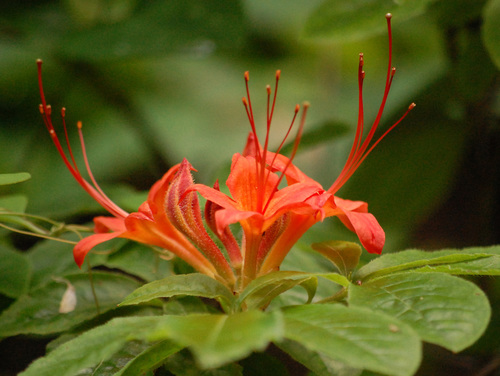


Flame Azalea
rhododendron calendulaceum
The Flame Azalea (Rhododendron calendulaceum) is widely considered one of the most spectacular native shrubs of the Appalachian Mountains. Exploding into color in late spring, its fiery blooms range from brilliant yellow and soft peach to vibrant orange and deep red, often resembling a hillside ablaze. This deciduous member of the heath family is celebrated for its stunning floral displays that typically emerge just before or alongside its new leaves. Early American naturalist William Bartram famously described it as the most brilliant and showy flowering shrub he had ever seen. Beyond its immense aesthetic appeal, it plays a vital ecological role in its mountain environment. It provides crucial nectar for a variety of native pollinators, including swallowtail butterflies and bumblebees, while employing specialized chemical defenses to ward off browsing mammals in its rugged, acidic woodland habitat.
Habitat: Found in upland forests, woodland slopes, and open mountain balds, typically thriving in well-drained, highly acidic soils.
Flame Azaleas are upright, loosely branched, deciduous shrubs that typically reach heights between 1.2 to 4.5 meters (4 to 15 feet). The most distinctive visual feature is their large, trumpet-shaped flowers, measuring 4 to 5 cm across, which grow in showy, terminal clusters of 5 to 9 blooms. The flower colors are highly variable, spanning a spectrum of yellow, apricot, orange, and scarlet, often featuring a prominent, contrasting orange blotch on the upper lobe. Its leaves are medium-green, alternate, and ovate to obovate, usually possessing fine hairs on their undersides, distinguishing them from scaly-leaved evergreen rhododendrons. In autumn, the foliage transitions to muted tones of yellow or pale red.
Category
PlantsRarity
Common
Danger
1/5 · Very low
Snaps
2
Because it belongs to the Rhododendron genus, its nectar contains grayanotoxins; if bees produce honey entirely from these flowers, it can result in a rare substance known as 'mad honey' which is intoxicating and mildly poisonous.
Despite its name, the shrub doesn't actually produce fire, but massive clusters of wild plants blooming simultaneously on Appalachian balds often look like a wildfire from a distance.
Early American botanist William Bartram famously described the Flame Azalea as the most animate, elegant, and flaming shrub he had ever seen during his travels in the 1700s.
Unlike evergreen rhododendrons, the Flame Azalea drops its leaves in winter, a crucial adaptation that prevents heavy ice and snow from snapping its branches in harsh mountain climates.
Produces toxic compounds called grayanotoxins in its leaves and nectar that effectively deter most mammalian herbivores from browsing.
Possesses a specialized root system capable of absorbing necessary nutrients in highly acidic, low-pH soils where many other plants would perish.
Features a prominent, intensely colored blotch on the upper petal of its flowers to visually guide specific insect pollinators directly to its nectar and pollen.
As a photosynthetic plant, it produces its own energy using sunlight, water, and atmospheric carbon dioxide.
Age differences: None, it remains a photosynthetic autotroph throughout its entire life cycle.

Papilio glaucus
Adult butterflies visit the flowers to drink nectar, inadvertently acting as a primary pollinator.

Bombus impatiens
Collects pollen and nectar from the blossoms, aiding significantly in the shrub's pollination.
Synanthedon rhododendri
Larvae of this clearwing moth bore into the stems and branches of the shrub, potentially causing localized dieback.
No trait badges are assigned for this object yet.
No aliases listed yet.
Collections for this object will appear here as more themes are added.
Danger
1/5 · Very low
No special safety notes yet.
The easiest way to identify Flame Azalea is to use the Snappit nature identifier app.
120-450 cm
20-75 years
As a photosynthetic plant, it produces its own energy using sunlight, water, and atmospheric carbon dioxide.
Found in upland forests, woodland slopes, and open mountain balds, typically thriving in well-drained, highly acidic soils.
Photosynthesis
Zoom in to split clusters and explore where this object has been snapped.

Tennessee, US
You might spot Black Bear, Yellow Wakerobin, and Pipevine Swallowtail.
View guide →

Virginia, US
You might spot Duck, Eastern Gray Squirrel, and Painted Turtle.
View guide →

North Carolina, US
You might spot Lesser Celandine, Bloodroot, and Little Sweet Betsy.
View guide →
Take the discovery with you
Snap it with Snappit to identify it, learn what makes it special, and add the discovery to your collection.












.jpg&width=800)



_001.jpg&width=800)




