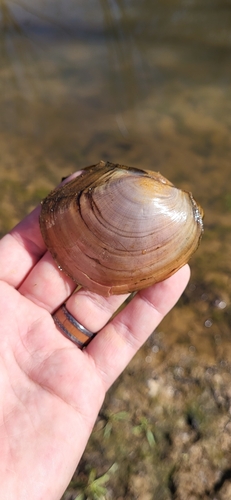


Flat Floater
utterbackiana suborbiculata
The Flat Floater (Utterbackiana suborbiculata) is a remarkably large and distinct freshwater mussel native to the quiet, muddy waters of North America. Known for its exceptionally flat, circular shell and thin, delicate structure, this bivalve is uniquely adapted to environments that would suffocate other mussel species. By spreading its weight across a wide surface area, it effectively floats on top of soft, unstable silt and mud bottoms. As ecosystem engineers, Flat Floaters play a vital role in maintaining aquatic health. Through continuous filter feeding, they clarify water, cycle nutrients, and provide microhabitats for benthic microorganisms, making them quiet champions of lake and river conservation.
Habitat: Found in quiet, slow-moving waters such as oxbow lakes, muddy ponds, and river sloughs with soft silt or mud substrates.
This mussel is easily recognized by its nearly circular, heavily compressed shell that can reach up to 18 centimeters in length. The shell is remarkably thin and fragile compared to other unionids. Its outer surface is typically a light yellowish-green to dark brown, often featuring fine green rays in younger specimens. Internally, the shell boasts a pearly, iridescent nacre that ranges from silvery-white to pinkish-orange, lacking well-developed hinge teeth.
Category
InvertebrateRarity
Common
Danger
1/5 · Very low
Snaps
Be the first to snap!
Its scientific name 'suborbiculata' directly translates to 'nearly circular', referring to its unique, disc-like shape.
The flat floater's shell is so incredibly thin and fragile that dry shells can often be crushed easily with light finger pressure.
Unlike most mussels that require clean gravel, this species prefers thick, gooey mud, earning its reputation as a true mud-dweller.
An extremely thin, lightweight, and broad shell allows the mussel to rest on soft, deep silt without sinking.
Its larvae attach to the fins or gills of specific host fish to safely disperse throughout aquatic systems.
It can survive in low-oxygen, stagnant water conditions that would be fatal to most other freshwater mussels.
Filters microscopic organic debris, algae, and bacteria directly from the slow-moving water column using its specialized gills.
No trait badges are assigned for this object yet.
No aliases listed yet.
Collections for this object will appear here as more themes are added.
Danger
1/5 · Very low
No special safety notes yet.
Compare body symmetry, shells, segments, legs, tentacles and how the animal moves. Invertebrates span many unrelated groups, so start with body structure. Invertebrate Identifier: upload a photo and compare the visible details.
10+ cm
0.1+ kg
5+ years
Filters microscopic organic debris, algae, and bacteria directly from the slow-moving water column using its specialized gills.
Found in quiet, slow-moving waters such as oxbow lakes, muddy ponds, and river sloughs with soft silt or mud substrates.
Filtering
50000+
Zoom in to split clusters and explore where this object has been snapped.
Recent snaps will appear here as new observations are added.

Alabama, US
You might spot Spanish Moss, Mediterranean House Gecko, and Anole.
View guide →

Alabama, US
You might spot Spanish Moss, Mapleleaf, and Mediterranean House Gecko.
View guide →
Take the discovery with you
Snap it with Snappit to identify it, learn what makes it special, and add the discovery to your collection.