Mossy Chiton
mopalia muscosa
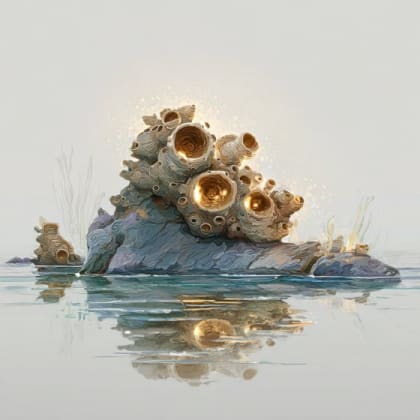
The Mossy Chiton is a fascinating creature that clings to rocks in the ocean. Its shell is covered in tiny, colorful algae that help it blend in with its surroundings!
Habitat: Coastal rocky shores and tide pools.
The Mossy Chiton has an oval, flattened body covered by eight overlapping shell plates. These plates are often dull green, brown, or black, heavily textured with fine bristles and algae, making it appear mossy. This natural texture helps it blend perfectly with its rocky surroundings.
Category
InvertebrateRarity
Common
Danger
0/5 · No known danger
Snaps
2
Despite having eyes, chitons can 'see' light and dark with hundreds of tiny light sensors on their shells!
If flipped over, a Mossy Chiton can slowly right itself by wiggling its powerful muscular foot.
Its 'teeth' are among the hardest biological materials, containing magnetite, a magnetic mineral!
They can live in the same spot for many years, slowly grazing on the same patch of rock.
Mossy Chitons can firmly grip rocks with a strong foot, which helps them resist powerful waves and predators.
It has eight articulated shell plates that overlap, allowing it to flex its body to fit tight crevices for safety.
Mossy Chitons have a radula, a ribbon-like tongue lined with incredibly hard teeth, to scrape algae off rocks.
Its textured, bristly shell grows algae, which helps it perfectly blend in with surrounding rocks, hiding from hungry birds.
They munch on tiny plants and algae that grow on rocks, using their special scraping 'tongue'.
Pisaster ochraceus
A common predator in tide pools.
Cancer productus
Crabs may dislodge and consume chitons.
Lottia digitalis
Often shares rocky surfaces and food sources.
Ulva lactuca
Consumes this common green algae.
Solitary animals live alone for most of their lives, only interacting with others for mating or parental care.
Camouflaged describes organisms that possess coloring or patterns that allow them to blend into their environment.
This trait characterizes organisms whose diet consists entirely or primarily of plant material.
Aquatic habitats encompass environments where organisms live predominantly in water, including oceans, rivers, lakes, and wetlands.

Marine habitats encompass all saltwater environments of the Earth's oceans, supporting an immense diversity of aquatic life.
Danger
0/5 · No known danger
No special safety notes yet.
The easiest way to identify Mossy Chiton is to use the Snappit nature identifier app.
5-10
5-30
5-15
They munch on tiny plants and algae that grow on rocks, using their special scraping 'tongue'.
Coastal rocky shores and tide pools.
Grazing
8
Zoom in to split clusters and explore where this object has been snapped.

California, US
You might spot Hilton's Aeolid and Opalescent Nudibranch.
View guide →

US
You might spot Ochre Sea Star and Giant Green Anemone.
View guide →

Washington, US
You might spot Mule Deer, Yellow Sand Verbena, and Bald Eagle.
View guide →

Washington, US
You might spot Red Fox, Ghost Pipe, and Armenian Blackberry.
View guide →
Take the discovery with you
Snap it with Snappit to identify it, learn what makes it special, and add the discovery to your collection.