

Florida Cross-Barred Venus
chione elevata
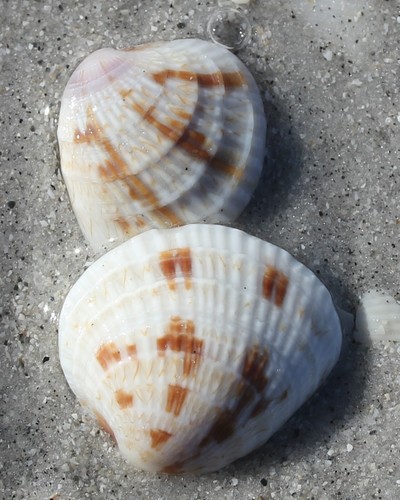
The Florida Cross-Barred Venus, scientifically known as Chione elevata, is a small, resilient marine bivalve commonly found along the southeastern coast of North America. This species is an integral part of sandy and muddy shallow water ecosystems, playing a crucial role as a filter feeder, helping to maintain water clarity by consuming suspended particles. Its attractive, ridged shell makes it a popular find for beachcombers and shell collectors, yet it remains largely overlooked in its ecological significance. Despite its modest size, the Florida Cross-Barred Venus exhibits remarkable adaptability to fluctuating coastal environments, making it a common and robust inhabitant of its estuarine and nearshore habitats.
Habitat: Found embedded in sandy or muddy substrates of shallow marine and estuarine environments, particularly in intertidal to subtidal zones.
The shell of the Florida Cross-Barred Venus is typically ovate to subtrigonal, moderately inflated, and can reach up to 5 cm (2 inches) in length. Its surface is characterized by prominent, concentric growth ridges that often intersect with finer radial ribs, creating a distinctive cross-barred or cancellate pattern. The color of the shell varies widely, ranging from off-white or cream to yellowish-brown, often with hints of gray, sometimes displaying radiating bands or blotches of darker pigmentation. The interior is smooth and typically white or porcelain-like, with a distinct pallial sinus and clear muscle scars.
Category
InvertebrateRarity
Common
Danger
1/5 · Very low
Snaps
Be the first to snap!
Like many bivalves, the Florida Cross-Barred Venus has separate sexes and reproduces by releasing eggs and sperm into the water, where fertilization and larval development occur.
Shells of the Florida Cross-Barred Venus are a common sight in beach drift lines, contributing to the diversity of shell collections along Gulf and Atlantic coasts.
The genus name 'Chione' refers to the Greek goddess of snow, possibly alluding to the often pale or white color of many shells in this group.
Like most bivalves, the Florida Cross-Barred Venus is an efficient filter feeder, drawing in seawater and straining microscopic plankton and detritus for sustenance. This process helps to clarify the water column and cycle nutrients.
It possesses a strong muscular foot that allows it to rapidly burrow into soft sediments, providing protection from predators and strong currents. This ability enables it to quickly re-bury itself if dislodged.
The variable coloration and intricate patterns on its shell provide natural camouflage against the sandy and muddy seafloor, making it difficult for visual predators to spot. This passive defense mechanism enhances its survival rate.
The Florida Cross-Barred Venus is a filter feeder, consuming microscopic organic particles suspended in the water column. It plays an important role in nutrient cycling within its ecosystem.

Callinectes sapidus
A significant predator in its habitat, often consuming bivalves.
Urosalpinx cinerea
Preys on bivalves by drilling through their shells.
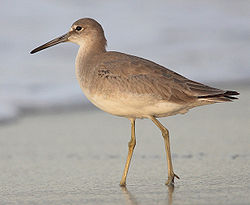
Tringa semipalmata
Forages in shallow waters, consuming small invertebrates including bivalves.
Mercenaria mercenaria
A common mollusc often coexisting in the same sandy environments.
No trait badges are assigned for this object yet.
No aliases listed yet.
Collections for this object will appear here as more themes are added.
Danger
1/5 · Very low
No special safety notes yet.
Compare the overall shape, opening, spiral, ribs, hinge and surface sculpture. Beach shells often lose the colors and sharp edges they had on the living animal, so shape does most of the work. Seashell Identifier: upload a photo and compare the visible details.
2-5 cm
0.005-0.02 kg
3-8 years
The Florida Cross-Barred Venus is a filter feeder, consuming microscopic organic particles suspended in the water column. It plays an important role in nutrient cycling within its ecosystem.
Found embedded in sandy or muddy substrates of shallow marine and estuarine environments, particularly in intertidal to subtidal zones.
Filtering
10000-50000
Zoom in to split clusters and explore where this object has been snapped.
Recent snaps will appear here as new observations are added.
Take the discovery with you
Snap it with Snappit to identify it, learn what makes it special, and add the discovery to your collection.