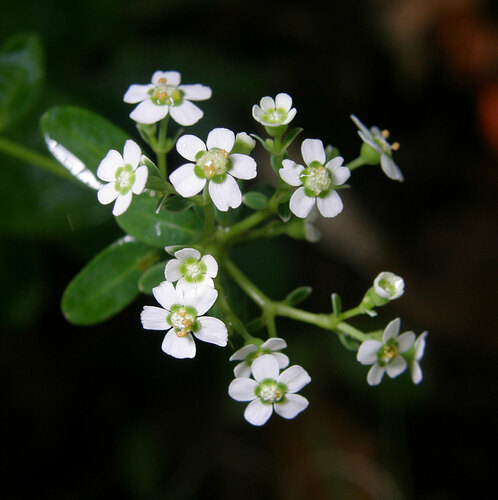


Flowering Spurge
euphorbia corollata
Flowering Spurge (Euphorbia corollata) is an elegant and resilient perennial wildflower native to the prairies and open woodlands of North America. Often mistaken for Baby's Breath due to its delicate, cloud-like clusters of white blossoms, this plant is actually a members of the spurge family. It thrives in dry, nutrient-poor soils where other plants struggle, acting as a crucial food source for diverse native pollinators during the hot summer months. Its deep taproot makes it highly drought-tolerant, and like other spurges, it features a distinctive milky white sap.
Habitat: Found in dry prairies, sandy savannas, rocky glades, and along sunny roadsides across central and eastern North America.
This species stands erect at heights between 30 and 90 cm, with smooth, light-green stems that branch near the upper portion. Its leaves are narrow, oblong, and light green, arranged alternately along the lower stem and whorled beneath the inflorescence. The most striking visual feature is the cluster of small flowers; what appear to be five white petals are actually modified leaves (bracts) surrounding tiny, yellow-green cyathia at the center. When any part of the stem or leaf is broken, a thick, white, milky sap quickly oozes out.
Category
PlantsRarity
Common
Danger
1/5 · Very low
Snaps
4
Historically, Native Americans utilized small, controlled doses of the root as a powerful purgative and laxative.
Its milky latex sap can cause severe skin irritation and blistering in humans, behaving similarly to poison ivy for sensitive individuals.
The apparent white petals of the Flowering Spurge are not petals at all, but modified leaves called bracts designed to lure insects.
Produces a toxic, sticky white latex sap containing euphol that deters herbivores and insects from feeding on its foliage.
Possesses a robust, deep-reaching taproot system that allows the plant to access deep water reserves during severe droughts.
Employs showy white bracts that mimic petals, efficiently attracting pollinators to its microscopic true flowers while saving energy.
As a photosynthetic plant, Flowering Spurge produces its own sugars using sunlight, water, and carbon dioxide while absorbing minerals from the soil.
Apis mellifera
Visits the tiny cyathia glands to feed on abundant nectar, aiding in pollination.
Hyles euphorbiae
The caterpillars feed on the foliage of the plant, tolerating the toxic sap.

Andropogon gerardii
Competes directly with Flowering Spurge for light, space, and soil moisture in tallgrass prairies.
No trait badges are assigned for this object yet.
No aliases listed yet.
Collections for this object will appear here as more themes are added.
Danger
1/5 · Very low
No special safety notes yet.
The easiest way to identify Flowering Spurge is to use the Snappit nature identifier app.
30-90 cm
3-10 years
As a photosynthetic plant, Flowering Spurge produces its own sugars using sunlight, water, and carbon dioxide while absorbing minerals from the soil.
Found in dry prairies, sandy savannas, rocky glades, and along sunny roadsides across central and eastern North America.
Photosynthesis
Zoom in to split clusters and explore where this object has been snapped.
Jun 18, 2026
Shaw Nature ReservePhoto attribution
(c) diana schwartz, some rights reserved (CC BY)
License: CC BY 4.0 ↗
Image may be shown cropped inside the card frame.
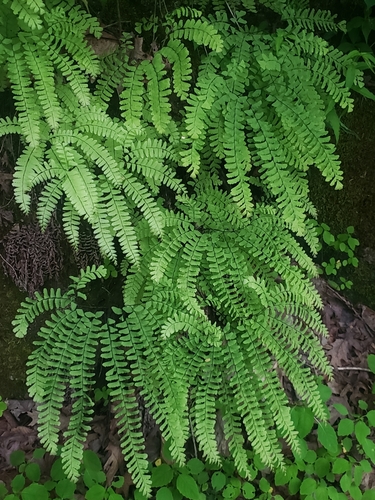
Iowa, US
You might spot Northern Maidenhair Fern and Wood Nettle.
View guide →

Illinois, US
You might spot Carolina Mantis and Goldenrod Soldier Beetle.
View guide →

Missouri, US
You might spot Painted-Cup Paintbrush and Great Spangled Fritillary.
View guide →

Wisconsin, US
You might spot Sundial Lupine, Canadian Lousewort, and Cream Wild-Indigo.
View guide →

Texas, US
You might spot Yaupon Holly, American Beautyberry, and Loblolly Pine.
View guide →

Wisconsin, US
You might spot Green Comet Milkweed, Wood Lily, and Flowering Spurge.
View guide →
Take the discovery with you
Snap it with Snappit to identify it, learn what makes it special, and add the discovery to your collection.











.jpg&width=800)



_001.jpg&width=800)




