

Fly Poison
amianthium muscitoxicum
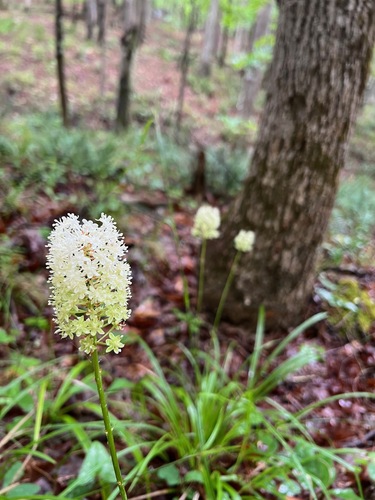
Fly poison (Amianthium muscitoxicum) is a striking, highly toxic perennial plant native to the eastern United States. Recognizable by its tall, dense clusters of starry white flowers that charmingly shift to a pale green as they mature, this plant adds dramatic flair to open woodlands and sandy pine barrens. Beyond its beauty, the plant holds a fascinating and slightly macabre history: early American settlers would crush its bulb, mix it with sugar or honey, and use the concoction as an effective, homemade insecticide to kill household flies. Despite its delicate appearance, Amianthium belongs to the Melanthiaceae family and packs a potent chemical defense mechanism. Its leaves, stems, and especially its bulb contain toxic alkaloids that act as severe neurological disruptors. This toxicity serves as a powerful deterrent against grazing herbivores, ensuring the plant's survival in its native habitats while making it a subject of caution for livestock owners and foragers alike.
Habitat: Typically found in moist to dry open woodlands, sandy pine barrens, and mountain meadows across the eastern United States.
Fly poison features basal, grass-like leaves that are linear, strap-shaped, and relatively thick, clustering near the ground at the bottom of the plant. During late spring and summer, it sends up a single, leafless, smooth stem reaching between 30 to 120 centimeters tall. The stem is crowned with a dense, striking, cylindrical raceme of star-shaped, six-petaled flowers. These delicate blossoms initially open as a pristine, bright white but uniquely transition to a yellowish-green or purplish-green as they age and begin to produce fruit.
Category
PlantsRarity
Common
Danger
1/5 · Very low
Snaps
Be the first to snap!
All parts of the plant are highly toxic and can cause a severe condition called 'staggers' in livestock, characterized by intense neurological distress, staggering movements, and rapid breathing.
The common name 'Fly Poison' comes from an early colonial practice of crushing the plant's bulbs and mixing them with molasses or honey to create a deadly trap for pesky houseflies.
The plant's scientific genus name, Amianthium, means 'unspotted flower' in Greek, referencing the pure, unblemished white of its newly opened blooms.
Produces powerful neurotoxic alkaloids, particularly in its bulb, which historically served as an insecticide and deters mammalian herbivores.
Its striking white flowers transition to a pale green as they age, visually signaling to pollinators which flowers are newly opened versus already pollinated.
Survives harsh winters and occasional surface fires by retreating into a hardy, subterranean bulb, allowing it to rapidly resprout in the spring.
Like most plants, Fly Poison creates its own food through photosynthesis, utilizing sunlight, water, and atmospheric carbon dioxide.
Bos taurus
Livestock mistakenly grazing on the plant suffer from severe poisoning, historically causing agricultural concerns.
Trichiotinus piger
Beetles are drawn to the small, white flowers for pollen and nectar, facilitating the plant's reproduction.
No trait badges are assigned for this object yet.
No aliases listed yet.
Collections for this object will appear here as more themes are added.
Danger
1/5 · Very low
No special safety notes yet.
Start with the whole plant, then compare leaf arrangement, leaf edges, stems and any flowers or fruit. Opposite leaves grow in pairs; alternate leaves come one at a time along the stem. These details tell you far more together than a single green leaf does. Plant Identifier: upload a photo and compare the visible details.
30-120 cm
5-30 years
Like most plants, Fly Poison creates its own food through photosynthesis, utilizing sunlight, water, and atmospheric carbon dioxide.
Typically found in moist to dry open woodlands, sandy pine barrens, and mountain meadows across the eastern United States.
Zoom in to split clusters and explore where this object has been snapped.
Recent snaps will appear here as new observations are added.
Take the discovery with you
Snap it with Snappit to identify it, learn what makes it special, and add the discovery to your collection.