
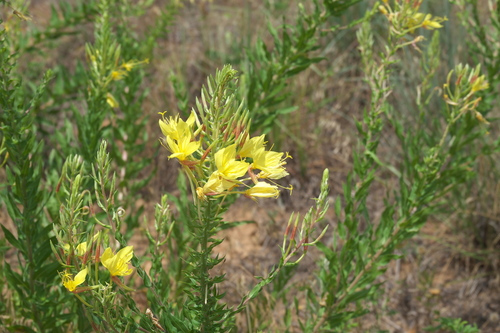


Fourpoint Evening Primrose
oenothera rhombipetala
The Fourpoint Evening Primrose is a striking biennial or annual wildflower native to the sandy regions of the central United States. It stands out in its native habitats due to its tall, erect spikes covered in numerous bright yellow flowers. Like other members of the evening primrose family, this plant plays a crucial ecological role by opening its blossoms late in the day, providing an essential nectar source for nocturnal and crepuscular insects, especially sphinx moths. Its ability to colonize nutrient-poor, sandy soils makes it a vital pioneer species that helps stabilize loose soil and prevent erosion.
Habitat: Typically found in sandy soils, sand prairies, open dunes, disturbed roadsides, and waste areas of the central United States.
This species typically grows as a single, hairy stem rising up to 100 centimeters. It features lance-shaped, greyish-green leaves that are lightly covered in fine hairs. The defining feature is the terminal spike of flowers, where each blossom displays four distinct, bright yellow petals that are noticeably diamond-shaped (rhombic) and taper to a point. The flowers open progressively from the bottom of the spike upward, accompanied by long, narrow floral bracts.
Category
PlantsRarity
Common
Danger
1/5 · Very low
Snaps
Be the first to snap!
Because it thrives in nutrient-poor sand, it is frequently used in ecological restoration projects to stabilize soils and initiate plant succession on degraded land.
The specific epithet 'rhombipetala' is a direct reference to the unique, diamond-like rhombic shape of its four yellow petals.
Unlike many plants that open flowers imperceptibly, the blossoms of this species can sometimes be observed unfolding in real-time at dusk within just a few minutes.
Opens its yellow blossoms rapidly at dusk to target nocturnal pollinators, such as hawkmoths, avoiding daytime nectar thieves.
Possesses a deep, robust taproot and specialized hairy foliage that allow it to anchor and thrive in dry, shifting sand dunes.
Produces seeds that can remain dormant in sandy soil seed banks for multiple years until ideal moisture and light levels occur.
As a photosynthetic autotroph, this plant synthesizes its own organic compounds using sunlight, water, carbon dioxide, and essential soil minerals.

Schinia florida
The caterpillar of this moth feeds directly on the developing flowers and seed pods of the primrose.
Hyles lineata
This large moth is a key nocturnal pollinator, drinking nectar from the freshly opened evening flowers.
Apis mellifera
Visits the flowers during the early morning hours before they wither in the midday heat, collecting remaining pollen.
No trait badges are assigned for this object yet.
No aliases listed yet.
Collections for this object will appear here as more themes are added.
Danger
1/5 · Very low
No special safety notes yet.
Start with the whole plant, then compare leaf arrangement, leaf edges, stems and any flowers or fruit. Opposite leaves grow in pairs; alternate leaves come one at a time along the stem. These details tell you far more together than a single green leaf does. Plant Identifier: upload a photo and compare the visible details.
30-100 cm
1-2 years
As a photosynthetic autotroph, this plant synthesizes its own organic compounds using sunlight, water, carbon dioxide, and essential soil minerals.
Typically found in sandy soils, sand prairies, open dunes, disturbed roadsides, and waste areas of the central United States.
Photosynthesis
Zoom in to split clusters and explore where this object has been snapped.
Recent snaps will appear here as new observations are added.
Take the discovery with you
Snap it with Snappit to identify it, learn what makes it special, and add the discovery to your collection.


















