





fringe cups
Tellima grandiflora
Fringe cups are lovely little plants with unique, cup-shaped flowers. They often grow in shady spots and can add a splash of color to the forest floor.
Habitat: Forests
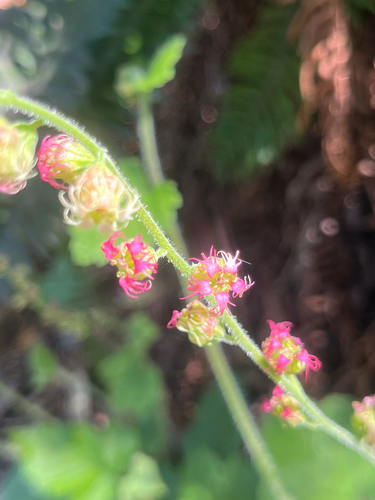
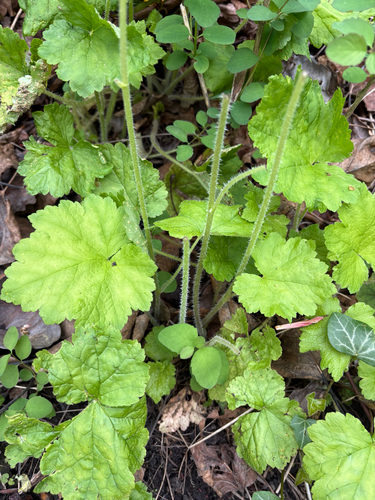
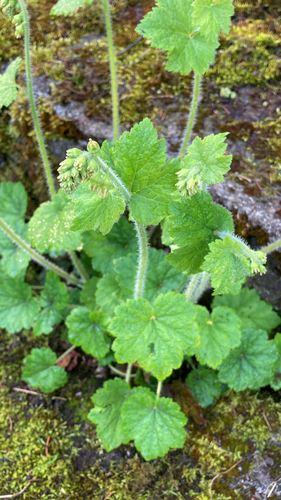
The fringe cups has a basal rosette of soft, hairy, lobed green leaves. Its tall, slender stems display delicate bell-shaped flowers with greenish-white petals that become pinkish-red, distinctly fringed at the edges like tiny lace.
Category
PlantsRarity
Common
Danger
1/5 · Very low
Snaps
15
Indigenous peoples of its range sometimes used the leaves as a poultice for minor wounds.
Its scientific name 'Tellima' is an anagram of 'Mitella', a closely related flower!
Look closely at the petals – they look like delicate, frilly eyelashes or tiny lace!
The tiny bell-shaped flowers actually change color from green-white to pink as they get older!
Fringe cups can thrive in deep forest shade, having adapted to grow with limited sunlight.
Fringe cups has uniquely fringed petals that attract specific small insect pollinators to its nectar.
Fringe cups can spread using underground stems called rhizomes, helping it form colonies.
Apis mellifera
visits flowers for nectar and pollen
Bombus mixtus
helps spread pollen between plants
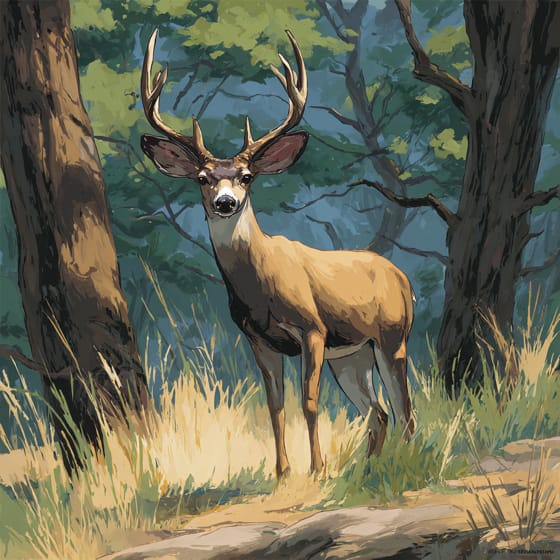
Odocoileus hemionus
may browse on its leaves and stems
Flowering plants are any plants that produce flowers as part of their reproductive cycle.
Shade tolerant plants are adapted to grow and thrive in areas with low light levels, requiring less direct sunlight.
Spring blooming plants produce their flowers during the spring season, often signifying the end of winter and the start of new growth.
Colorful describes organisms or objects displaying a wide range of bright and distinct colors.

Describes plants that are particularly attractive and beneficial to a wide range of pollinating organisms.

Forest habitats are terrestrial environments dominated by dense tree cover, supporting a high diversity of plant and animal life.
No aliases listed yet.
Danger
1/5 · Very low
Always look but don't touch plants unless an adult says it's okay.
The easiest way to identify fringe cups is to use the Snappit nature identifier app.
30-70 cm
20-40 cm
0.5-1 cm
Spring to early summer
No
None
Perennial
Zoom in to split clusters and explore where this object has been snapped.
May 10, 2026
Huckleberry Botanic Regional PreservePhoto attribution
no rights reserved
License: CC0 1.0 ↗
Image may be shown cropped inside the card frame.
Apr 15, 2026
FairhavenPhoto attribution
(c) Arden Hoover, some rights reserved (CC BY)
License: CC BY 4.0 ↗
Image may be shown cropped inside the card frame.
Apr 25, 2025
FairhavenPhoto attribution
(c) larndesolen, some rights reserved (CC BY)
License: CC BY 4.0 ↗
Image may be shown cropped inside the card frame.

Washington, US
You might spot Bigleaf Maple, Mule Deer, and Oregon Grape.
View guide →

Washington, US
You might spot Rock Pigeon, American Crow, and Pigeon Guillemot.
View guide →

Alaska, US
You might spot Bald Eagle, Salmonberry, and Ochre Sea Star.
View guide →

Washington, US
You might spot Surf Scoter, Horned Grebe, and Salmonberry.
View guide →

British Columbia, CA
You might spot Western Rattlesnake Plantain and Shinyleaf Meadowsweet.
View guide →

Washington, US
You might spot Northern Flicker, American Robin, and Great Blue Heron.
View guide →
Take the discovery with you
Snap it with Snappit to identify it, learn what makes it special, and add the discovery to your collection.







.jpg&width=800)



_001.jpg&width=800)



