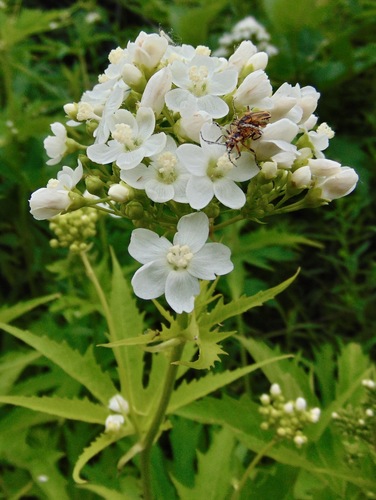


Glade Mallow
napaea dioica
Glade Mallow (Napaea dioica) is a captivating perennial herb known for its striking height and unique reproductive strategy. Unlike most plants, it is dioecious, meaning individual plants bear either male or female flowers exclusively. This tall, stately member of the mallow family adds an elegant touch to moist meadows and riverbanks, its robust stature making it stand out in its native habitats. Its relative rarity in much of its historical range underscores its ecological importance and the need for conservation efforts to protect this fascinating botanical specimen.
Habitat: Glade Mallow thrives in rich, moist soils found in open woodlands, stream banks, wet prairies, and alluvial floodplains, often requiring sunny or partially shaded conditions.
This robust perennial can reach heights of 1 to 3 meters. Its stems are stout, often reddish, and covered with fine, star-shaped hairs. The large, palmately lobed leaves resemble those of a maple, with 5-7 deep lobes and toothed margins. Flowers are relatively small, about 1-2 cm across, white to cream-colored, and clustered in terminal panicles. Male flowers have prominent stamens, while female flowers feature a central pistil, a distinction only visible upon close inspection on separate plants.
Category
PlantsRarity
Common
Danger
1/5 · Very low
Snaps
1
Despite its striking appearance and ecological significance, Glade Mallow is not widely cultivated, making the preservation of its wild populations critical for its survival.
Glade Mallow is one of the few dioecious species within the large Malvaceae (mallow) family, meaning individual plants are either male or female.
It was first described by Carl Linnaeus in 1753, initially placed in the genus Sida, before being reclassified into its own genus, Napaea.
Its common name "Glade Mallow" aptly describes its preference for open, moist forest openings or prairie glades.
Male and female reproductive organs are on separate plants, ensuring cross-pollination and genetic diversity, a less common strategy among flowering plants.
Capable of growing quite tall in a single season, allowing it to compete effectively for sunlight in its preferred open and partially shaded habitats.
Possesses a fibrous root system that can include rhizomes, enabling vegetative spread and the formation of colonies, contributing to its persistence in suitable locations.
Glade Mallow produces its own food through photosynthesis, converting sunlight into energy. It absorbs water and essential mineral nutrients from the soil via its root system to support growth and metabolic processes.
Bombus spp.
Pollination for reproduction.

Odocoileus virginianus
Herbivory, feeding on leaves and stems.
Strymon melinus
Provides host for larvae.
Rodentia (various species)
Seed dispersal, often by clinging to fur or consumed.
No trait badges are assigned for this object yet.
No aliases listed yet.
Collections for this object will appear here as more themes are added.
Danger
1/5 · Very low
No special safety notes yet.
The easiest way to identify Glade Mallow is to use the Snappit nature identifier app.
100-300 cm
0.5-3 kg
3-10 years
Glade Mallow produces its own food through photosynthesis, converting sunlight into energy. It absorbs water and essential mineral nutrients from the soil via its root system to support growth and metabolic processes.
Glade Mallow thrives in rich, moist soils found in open woodlands, stream banks, wet prairies, and alluvial floodplains, often requiring sunny or partially shaded conditions.
Photosynthesis/nutrient Absorption
50-500
Zoom in to split clusters and explore where this object has been snapped.
Take the discovery with you
Snap it with Snappit to identify it, learn what makes it special, and add the discovery to your collection.













.jpg&width=800)



_001.jpg&width=800)




