





golden ragwort
Packera aurea
Golden ragwort is a bright yellow flower that blooms in spring. It grows in clumps and is often found in meadows and along roadsides, making the world a little brighter!
Habitat: Meadows
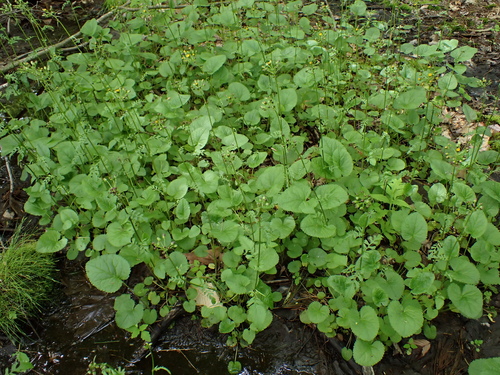
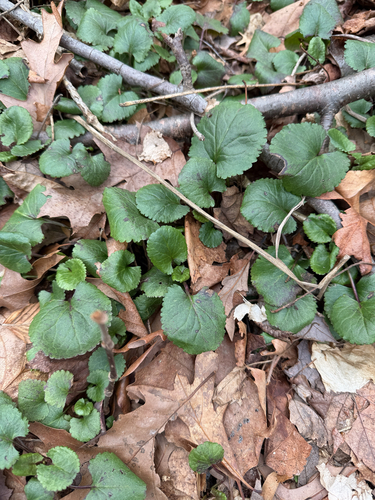
The golden ragwort has bright yellow, daisy-like flowers with many thin ray petals surrounding a dense central disc. These vibrant blooms sit atop sturdy, reddish-green stems, while its basal leaves are often dark green and heart-shaped. Its distinctive appearance makes it stand out in early spring.
Category
PlantsRarity
Common
Danger
1/5 · Very low
Snaps
10
Each flower head is actually a cluster of tiny individual flowers, not just one!
Early Americans used parts for medicine, but it's best not to try it yourself!
Its scientific name, 'aurea,' means golden, just like its dazzling flowers!
This plant is a super-spreader, forming carpets of gold across forest floors!
Golden ragwort can quickly form colonies using underground stems, helping it claim its space in meadows.
This plant thrives in both sun and shade, allowing it to grow in diverse forest and field environments.
Golden ragwort produces special chemicals that make it unpalatable to most grazing animals, protecting its leaves.
Apis mellifera
Provides nectar and pollen for honey bees.
Bombus impatiens
Offers vital early spring nectar to bumblebees.
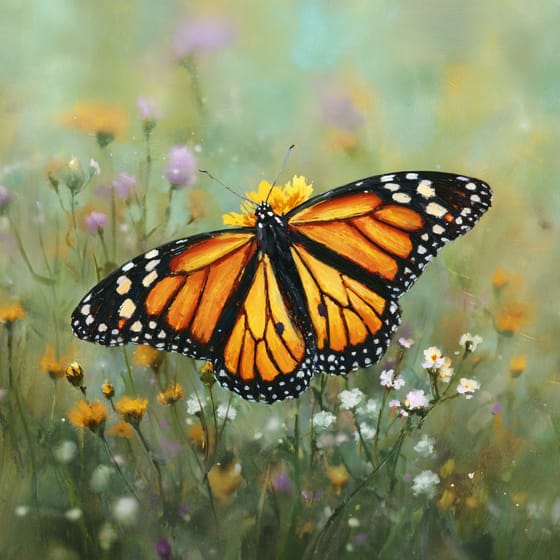
Danaus plexippus
Butterflies like the monarch visit for nectar.
Flowering plants are any plants that produce flowers as part of their reproductive cycle.
Cluster flowers are inflorescences where individual flowers are arranged closely together on a common stem.
Shade tolerant plants are adapted to grow and thrive in areas with low light levels, requiring less direct sunlight.
Spring blooming plants produce their flowers during the spring season, often signifying the end of winter and the start of new growth.

Colorful describes organisms or objects displaying a wide range of bright and distinct colors.

Grassland habitats are terrestrial biomes dominated by grasses and herbaceous plants, supporting a variety of grazing animals.

Describes plants that are particularly attractive and beneficial to a wide range of pollinating organisms.
No aliases listed yet.
Danger
1/5 · Very low
Always look but don't touch flowers without asking an adult first.
The easiest way to identify golden ragwort is to use the Snappit nature identifier app.
30-90 cm
30-60 cm
1-2.5 cm
Spring
No
Moderate
Perennial
Zoom in to split clusters and explore where this object has been snapped.
May 27, 2026
Pittsfield Center Historic DistrictPhoto attribution
(c) Steven Lamonde, some rights reserved (CC BY)
License: CC BY 4.0 ↗
Image may be shown cropped inside the card frame.
Mar 15, 2026
South Mountain ReservationPhoto attribution
(c) Tom Pollard, some rights reserved (CC BY)
License: CC BY 4.0 ↗
Image may be shown cropped inside the card frame.

Pennsylvania, US
You might spot Pinesap, Great Rhododendron, and Mountain Laurel.
View guide →

Massachusetts, US
You might spot Hemlock Woolly Adelgid, Eastern Newt, and Red Trillium.
View guide →

Michigan, US
You might spot Prairie Trillium, Large White Trillium, and Wild Geranium.
View guide →

New Jersey, US
You might spot American Wintergreen, Wild Geranium, and Mayapple.
View guide →
Ohio, US
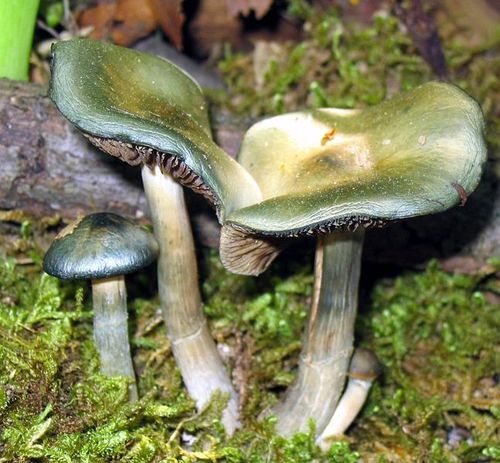
You might spot Psychedelic Ovoid Mushroom and Powdered Dancer.
View guide →

West Virginia, US
You might spot Wide Leek, Eastern Newt, and Golden Ragwort.
View guide →
Take the discovery with you
Snap it with Snappit to identify it, learn what makes it special, and add the discovery to your collection.







.jpg&width=800)



_001.jpg&width=800)



