





Virginia Saxifrage
micranthes virginiensis
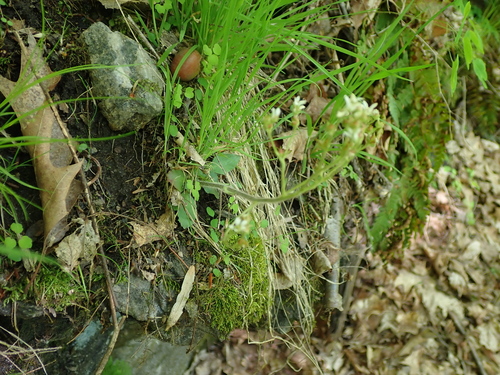
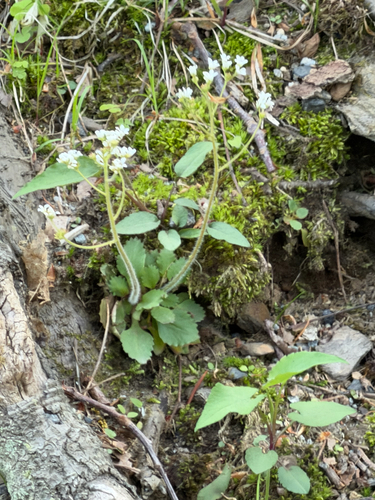
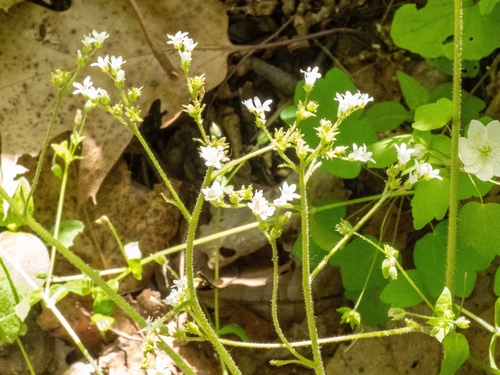
Virginia Saxifrage is a lovely little plant that blooms with delicate white flowers in spring. It loves to grow in rocky areas, making it a special find for nature explorers!
Habitat: It lives in rocky woodlands and along stream banks.
The Virginia Saxifrage has a basal rosette of green, often reddish-tinged leaves close to the ground. From this, a leafless stem rises, topped with delicate, star-shaped white flowers, often with yellow or orange centers, making it easy to spot against dull early spring landscapes.
Category
PlantsRarity
Common
Danger
0/5 · No known danger
Snaps
23
Even in winter, its basal leaves stay green, ready for quick spring growth!
It's one of the very first wildflowers to bloom, feeding sleepy early insects!
Its name 'saxifrage' means 'rock-breaker,' for plants that grow in cracks!
Tiny hairs on its leaves help it save water in dry, rocky spots.
Virginia Saxifrage can root deeply into rock crevices, anchoring itself firmly in otherwise tough, rocky environments.
Virginia Saxifrage can bloom very early in spring, giving it a head start on pollination before other plants leaf out.
Virginia Saxifrage has a tight rosette of basal leaves which helps it conserve precious moisture close to the ground.
Apis mellifera
Provides early spring nectar
Bombus impatiens
Visits flowers for pollen
Limax maximus
Slugs may graze on its leaves
Colorful describes organisms or objects displaying a wide range of bright and distinct colors.
This trait characterizes organisms whose diet consists entirely or primarily of plant material.
Forest habitats are terrestrial environments dominated by dense tree cover, supporting a high diversity of plant and animal life.
Describes organisms that transfer pollen, enabling the fertilization and reproduction of plants.
Danger
0/5 · No known danger
No special safety notes yet.
The easiest way to identify Virginia Saxifrage is to use the Snappit nature identifier app.
10-30 cm
15-25 cm
0.5-1 cm
Early spring
Yes
None
Perennial
Zoom in to split clusters and explore where this object has been snapped.
May 17, 2026
Berkshire Botanical GardenPhoto attribution
no rights reserved
License: CC0 1.0 ↗
Image may be shown cropped inside the card frame.
May 5, 2026
Lebanon Green Historic DistrictPhoto attribution
(c) Sawyer Baran, some rights reserved (CC BY)
License: CC BY 4.0 ↗
Image may be shown cropped inside the card frame.
May 3, 2026
Crystal GrottoesPhoto attribution
no rights reserved
License: CC0 1.0 ↗
Image may be shown cropped inside the card frame.

Massachusetts, US
You might spot Common Eastern Bumble Bee and Eastern Skunk Cabbage.
View guide →

Vermont, US
You might spot Japanese Knotweed and Red-Bellied Woodpecker.
View guide →

Pennsylvania, US
You might spot Large Yellow Underwing and Eastern Black Carpenter Ant.
View guide →

Connecticut, US
You might spot Osprey, Monarch, and Common Reed.
View guide →
Kentucky, US
You might spot Jack-In-The-Pulpit and Prairie Trillium.
View guide →

New Hampshire, US
You might spot Eastern Newt, Common Loon, and Hickory Tussock Moth.
View guide →
Take the discovery with you
Snap it with Snappit to identify it, learn what makes it special, and add the discovery to your collection.








.jpg&width=800)



_001.jpg&width=800)




