
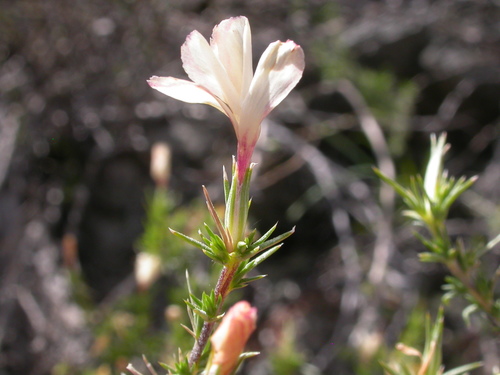


Granite Prickly Phlox
linanthus pungens
Granite Prickly Phlox (Linanthus pungens) is a hardy, aromatic subshrub that thrives where few other plants can—clinging to the rocky, sun-baked crevices of western North America's mountains. True to its name, this resilient perennial features highly branched, woody stems covered in stiff, needle-like leaves that form a prickly, defensive cushion. Despite its tough, protective exterior, it bursts into a delicate display of funnel-shaped, fragrant blossoms that range from pure white to soft pink or pale yellow. These blossoms are nocturnal adapters, opening primarily during the cool of the evening and night to attract specialized night-flying pollinators like hawkmoths. This striking contrast between sharp, protective foliage and sweet-scented, ephemeral flowers makes the Granite Prickly Phlox a fascinating and rugged beauty of arid montane landscapes.
Habitat: Found in dry, rocky or sandy soils, often anchoring to granite outcrops, talus slopes, and sagebrush scrublands at montane to subalpine elevations.
This low-growing, mat-forming subshrub typically reaches heights of 10 to 40 centimeters. It features highly branched, woody bases with stiff, palmate leaves divided into 3 to 7 needle-sharp, prickle-tipped segments, giving the plant a spiny appearance. The fragrant flowers are tubular or funnel-shaped, 1.5 to 2.5 centimeters long, boasting five spreading lobes that are typically white, cream, or light pink, often showing a yellowish throat.
Category
PlantsRarity
Common
Danger
1/5 · Very low
Snaps
Be the first to snap!
Despite its delicate-looking flowers, the leaves of the Granite Prickly Phlox are sharp enough to pierce lightweight hiking pants and socks!
The flowers exhibit nyctinasty, opening in the cool evening and closing during the heat of the day to conserve precious moisture.
When crushed, the foliage of this plant releases a strong, pungent, sweet-skunky aroma typical of many members of the phlox family.
Stiff, needle-like leaves minimize water loss through transpiration while physically deterring herbivores in arid climates.
Flowers open in the evening and release a sweet scent to attract nocturnal pollinators like moths, avoiding daytime water loss.
A deep, woody taproot system anchors the plant firmly in unstable talus, granite cracks, and rocky soils.
Synthesizes its own food using sunlight, water, and carbon dioxide through photosynthesis, utilizing deep roots to draw scarce moisture and minerals from rocky soils.
Hyles lineata
Pollinates the flowers while feeding on nectar during the evening.

Artemisia tridentata
Shares dry, sandy, and rocky soils in chaparral and scrubland ecosystems.
Ovis canadensis nelsoni
May occasionally browse on the plant, though the sharp needles deter intensive grazing.
No trait badges are assigned for this object yet.
No aliases listed yet.
Collections for this object will appear here as more themes are added.
Danger
1/5 · Very low
No special safety notes yet.
Start with the whole plant, then compare leaf arrangement, leaf edges, stems and any flowers or fruit. Opposite leaves grow in pairs; alternate leaves come one at a time along the stem. These details tell you far more together than a single green leaf does. Plant Identifier: upload a photo and compare the visible details.
10-40 cm
5-20 years
Synthesizes its own food using sunlight, water, and carbon dioxide through photosynthesis, utilizing deep roots to draw scarce moisture and minerals from rocky soils.
Found in dry, rocky or sandy soils, often anchoring to granite outcrops, talus slopes, and sagebrush scrublands at montane to subalpine elevations.
Zoom in to split clusters and explore where this object has been snapped.
Recent snaps will appear here as new observations are added.

New Mexico, US
You might spot Pinkflower Hedgehog Cactus and Kingcup Cactus.
View guide →

Oregon, US
You might spot Granite Prickly Phlox, Red-Tailed Hawk, and Pronghorn.
View guide →
Take the discovery with you
Snap it with Snappit to identify it, learn what makes it special, and add the discovery to your collection.

















