





grasswidow
Olsynium douglasii
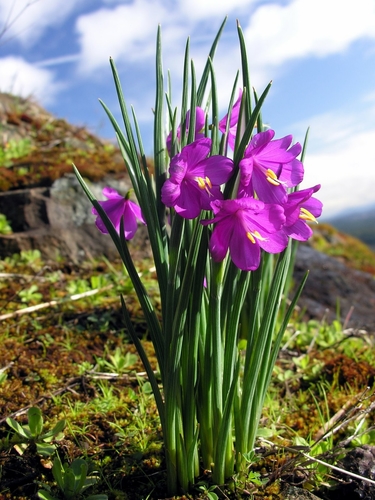
Grasswidow is a pretty little flower that blooms in spring. It has delicate petals that can be purple or white, and it loves to grow in grassy areas.
Habitat: Grasslands
The grasswidow has slender, grass-like leaves and bright, deep purple to magenta cup-shaped flowers. Its striking blossoms often feature a vibrant yellow eye or center, making them stand out against the early spring landscape. These beautiful blooms grow on thin stems.
Category
PlantsRarity
Common
Danger
1/5 · Very low
Snaps
1
Each delicate flower only lasts for a single day, then a new one opens!
It belongs to the iris family, even though its leaves look like grass!
Its vibrant purple flowers are one of the first splashes of color in spring!
The 'widow' in its name means it blooms before the grass gets tall!
Grasswidow can sprout and bloom very early in spring, getting a head start before other plants grow tall.
Grasswidow has bulb-like structures underground that store energy, helping it survive winter and bloom early.
Grasswidow opens its flowers only on sunny days, ensuring pollinators are active when its blooms are ready.

Bombus vosnesenskii
Visits flowers for nectar and pollen.
Apis mellifera
An important generalist pollinator.

Syrphus ribesii
Larvae eat aphids; adults pollinate.
Flowering plants are any plants that produce flowers as part of their reproductive cycle.
Spring blooming plants produce their flowers during the spring season, often signifying the end of winter and the start of new growth.
Drought-tolerant plants can survive and flourish in conditions with limited water availability.
Colorful describes organisms or objects displaying a wide range of bright and distinct colors.

Grassland habitats are terrestrial biomes dominated by grasses and herbaceous plants, supporting a variety of grazing animals.

Describes plants that are particularly attractive and beneficial to a wide range of pollinating organisms.
No aliases listed yet.
Danger
1/5 · Very low
Always look but don't pick flowers, so everyone can enjoy them!
The easiest way to identify grasswidow is to use the Snappit nature identifier app.
10-30 cm
5-15 cm
2-4 cm
Early spring (March-May)
No
None
Perennial
Zoom in to split clusters and explore where this object has been snapped.

Washington, US
You might spot Arrowleaf Balsamroot and Canada Goose.
View guide →
Washington, US
You might spot Duck, Yellow-Bellied Marmot, and Canada Goose.
View guide →

Washington, US
You might spot Eastern Gray Squirrel, Yellow-Bellied Marmot, and Duck.
View guide →

Washington, US
You might spot Duck, Common Alkanet, and Arrowleaf Balsamroot.
View guide →

Oregon, US
You might spot Western Ponderosa Pine and Red-Winged Blackbird.
View guide →
British Columbia, CA
You might spot Grasswidow and Broad-Leaved Stonecrop.
View guide →
Take the discovery with you
Snap it with Snappit to identify it, learn what makes it special, and add the discovery to your collection.








.jpg&width=800)



_001.jpg&width=800)




